Heat pump tax credit 2026: it expired — here’s what replaced it
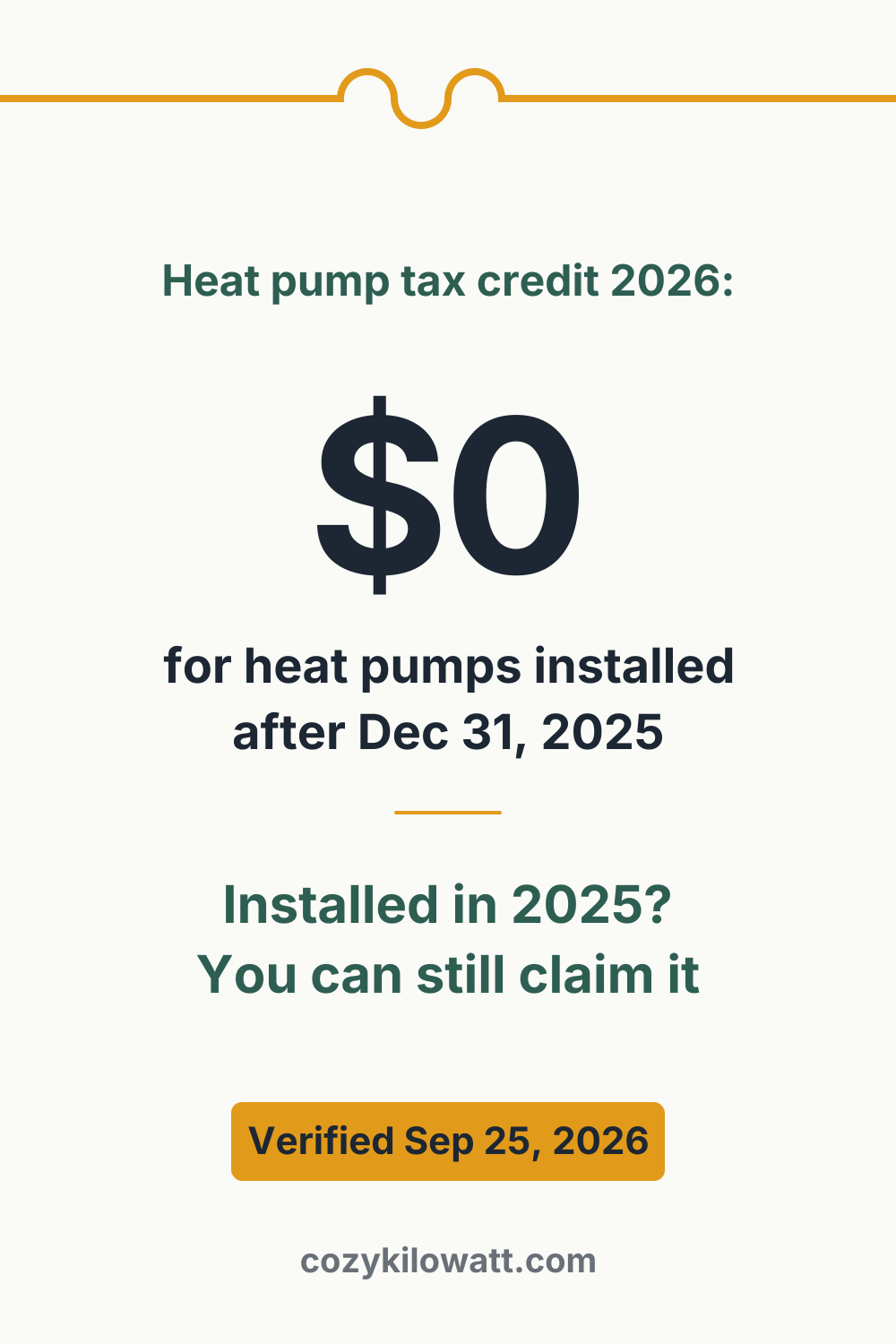
There is no federal tax credit for a heat pump installed in 2026. The 25C credit — 30% of cost, up to $2,000 a year — ended for heat pumps placed in service after December 31, 2025, and the 25D credit for geothermal heat pumps ended the same day, both under the One Big Beautiful Bill Act (P.L. 119-21). A 2025 installation can still be claimed on your 2025 return with Form 5695. For 2026 projects, federal money comes only through state-run rebates — HEEHR (formerly HEAR, up to $14,000) and HOMES (up to $8,000) — alongside state and utility programs.
The federal picture for 2026 installs
| Incentive | What it paid | Status for 2026 installs | Who runs it |
|---|---|---|---|
| 25C — heat pumps, heat pump water heaters | 30% of cost, up to $2,000 per year | Ended for property placed in service after Dec. 31, 2025 | IRS (Form 5695, Part II) |
| 25C — insulation, windows, doors, panels, audits | 30% of cost, up to $1,200 per year | Ended on the same date | IRS (Form 5695, Part II) |
| 25D — geothermal heat pumps, solar, batteries | 30% of cost, no annual cap | Ended for expenditures after Dec. 31, 2025; unused credit still carries forward | IRS (Form 5695, Part I) |
| HEEHR (formerly HEAR) | Up to $14,000 per household; up to $8,000 for a heat pump | Open in some states; electric-to-electric only since May 29, 2026 | State energy offices, income ≤150% AMI |
| HOMES | Up to $8,000, based on modeled savings of 20% or more | Open in some states, every income level | State energy offices |
| State and utility programs | Varies — EmPOWER Maryland pays up to $15,000 | Open; set by each state or utility | States, utilities, cities |
Did the heat pump tax credit expire? Yes — on December 31, 2025
The 25C Energy Efficient Home Improvement Credit was written to run through 2032 under the Inflation Reduction Act. The One Big Beautiful Bill Act, signed July 4, 2025 as Public Law 119-21, cut it short: the 2025 Form 5695 instructions state that the credit cannot be claimed for expenditures or property placed in service after December 31, 2025. The trigger is the installation, not the purchase. A heat pump bought in December and switched on in January is a 2026 heat pump, and it gets nothing from 25C. The same law ended 25D, the Residential Clean Energy Credit for geothermal heat pumps, solar panels and batteries, for expenditures made after that date — and 25D treats an expenditure as made when the installation is completed. No transition relief exists for contracts signed or deposits paid in 2025. If a contractor quotes you a 30% federal tax credit on a 2026 installation, the quote is wrong.
Installed in 2025? You can still claim it
A heat pump placed in service on or before December 31, 2025 still earns the credit on your 2025 federal return: 30% of the installed cost, up to $2,000, claimed on Form 5695, Part II. Three conditions decide whether it survives review. First, the equipment had to meet the Consortium for Energy Efficiency’s highest non-advanced tier in effect at the start of 2025. Second, for property placed in service in 2025, the IRS allows no credit unless the item came from a qualified manufacturer and you report its four-character Qualified Manufacturer Identification Number (QMID) — get it from your installer in writing. Third, 25C is nonrefundable with no carryforward: any amount above your 2025 tax liability is lost. If you extended your 2025 return, the filing deadline is October 15, 2026. If you already filed without the credit, Form 1040-X can generally claim it within three years of your original filing date.
Geothermal is different: 25D and its carryforward
Geothermal heat pumps never ran through 25C. They sat under 25D, the Residential Clean Energy Credit: 30% of the full installed cost with no annual dollar cap. That credit is also closed to new systems — a geothermal loop completed after December 31, 2025 earns nothing federally, even if drilling started in 2025. The difference that matters is the carryforward. Unlike 25C, an unused 25D credit rolls into future tax years, and the Congressional Research Service confirms the 2025 law did not change that rule. A household that installed a $40,000 geothermal system in 2025 generated a $12,000 credit; if its 2025 tax bill was $7,000, the remaining $5,000 carries into 2026 and beyond. Several state credits also survive the federal cut — New York pays 25% of geothermal costs, up to $10,000, for systems placed in service on or after July 1, 2025.
What replaced the heat pump tax credit
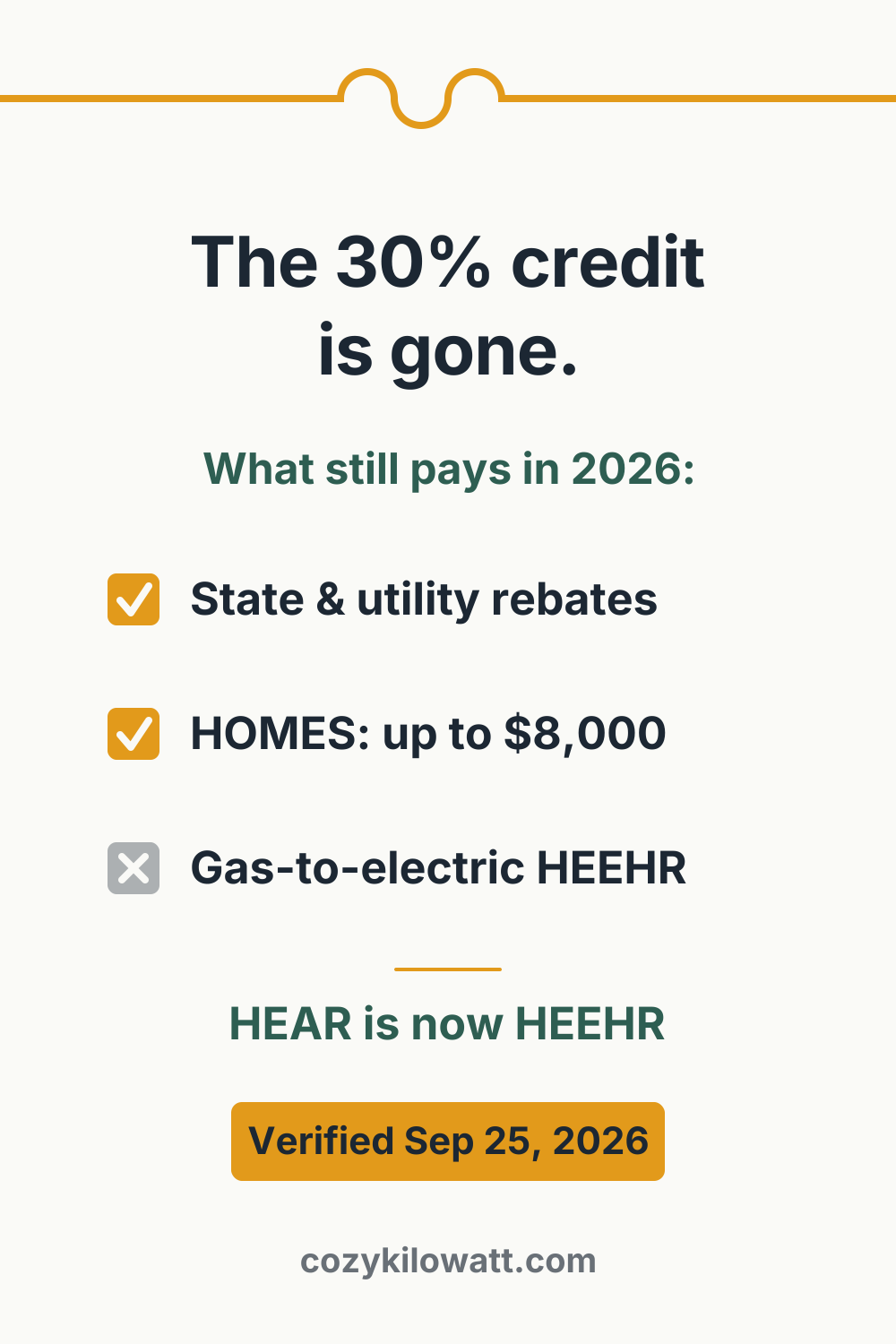
No federal tax credit replaced 25C. The federal money that remains for heat pumps is rebate money appropriated by the Inflation Reduction Act and handed to states, which design, launch and run their own programs on their own calendars. There are two: HEEHR, which pays fixed amounts per upgrade to income-qualified households, and HOMES, which pays for measured whole-home savings at any income. The U.S. Department of Energy describes HEEHR as worth up to $14,000 per household and HOMES as worth up to $8,000, with states allowed to go higher for households below 80% of Area Median Income. Two practical differences from the old credit decide everything: a rebate usually arrives at the time of purchase instead of at tax time, and it exists only where your state has launched. In several states, state and utility programs now pay more than 25C ever did. Our state-by-state registry tracks who is paying today.
HEAR is now HEEHR: the May 29, 2026 rule change
Most guides still call the federal electrification rebate “HEAR.” On May 29, 2026, the Department of Energy renamed it the High-Efficiency Electric Home Rebate program (HEEHR) in Program Notice 26-2 — and changed what it pays for. HEEHR no longer funds fuel switching: heating, cooling and appliance rebates now cover only upgrades from existing electric equipment to more efficient electric equipment, with electric systems in new construction still allowed. Homes must also insulate and air-seal before the heat pump, unless they already meet a DOE-approved state standard. The notice keeps one flexibility many readers want: a home may keep its fossil system as backup when adding a heat pump. States already running the program had three months to comply — the window in which Wisconsin announced it would stop retail rebates for fossil replacements from September 1. Reservations approved under the old rules are still honored. Some states still use the old name.
HEAR vs HOMES: which federal rebate fits your project
The two programs answer different questions. HEEHR asks what you are installing: each upgrade has a fixed ceiling — up to $8,000 for a heat pump, $1,750 for a heat pump water heater, $4,000 for an electrical panel, $2,500 for wiring and $1,600 for insulation, air sealing and ventilation, capped at $14,000 per household. It is limited to households at or below 150% of Area Median Income, covering 100% of costs below 80% AMI and 50% between 80% and 150%. HOMES asks how much energy the whole house will save: a modeled reduction of at least 20% unlocks a rebate at any income, with higher amounts for deeper savings and for lower-income households. Wisconsin, for example, pays up to $10,000 through HOMES. You cannot collect both programs for the same upgrade, and states set the final amounts. If your income is above 150% AMI, HOMES is the only federal door — where your state has opened it.
Where the federal rebates stand in the states we have verified
- New York — federal dollars flow through EmPower+; state-funded Sustainable Futures adders and NYS Clean Heat carry the large heat pump amounts.
- Wisconsin — both programs live since 2024; HEAR up to $14,000, HOMES up to $10,000; retail rebates for fossil replacements ended September 1, 2026.
- Maryland — HEAR and HERO not launched; EmPOWER Maryland pays up to $15,000 right now.
- Colorado — single-family HEAR closed statewide; the state credit, Xcel and Power Ahead still pay.
- Washington — the federal program has not launched and will not be retroactive; a separate state-funded HEAR is open.
- Georgia — HER (Georgia’s HOMES) open, up to $16,000; HEAR submissions paused until further notice.
The mistakes still circulating in 2026
We read the guides that rank for this question before writing this page. Four errors keep appearing in articles published or updated in 2026. Some still present the 25C limits as available for 2026 and claim they “reset” for 2027 — they do not; the credit is gone. Some state that the 30% federal credit for heat pumps “remains available” — it does not, for any fuel type. Some say geothermal heat pumps keep a 30% federal credit through 2032 — that was the Inflation Reduction Act schedule, repealed in 2025. Part of the blame sits with the IRS itself: its FAQ overview page, last updated January 18, 2026, still describes 25C as running through 2032 and 25D through 2034. And many describe HEAR’s $8,000 heat pump rebate as the replacement for a gas furnace swap — since May 29, 2026, HEEHR no longer funds that switch. Every correction on this page links to its primary source, and each one is logged, with its date, in our public corrections log.
Before you sign a quote: what we’d verify
- No 30% federal line item. A 2026 quote that subtracts a federal tax credit is using a program that no longer exists. Ask for the incentives by name.
- Which rebate, and whether your project qualifies. If you are replacing gas, oil or propane heat, federal HEEHR will not pay; ask which state or utility program will, and get it in writing before you sign.
- Envelope first. HEEHR now requires insulation and air sealing before the heat pump in most homes — price both, in that order. What insulation pays in 2026: insulation rebates 2026.
- A 2025 install? Get the QMID for each item and the placed-in-service date on your invoice; without the QMID, the IRS allows no credit.
- A real Manual J load calculation. Rebates shrink every year; an oversized system wastes them for its whole life.
Sources and method
Every fact on this page was checked on September 25, 2026 against primary sources: the IRS Energy Efficient Home Improvement Credit page (caps, QMID rule, no carryforward), the 2025 Form 5695 instructions (termination language for 25C and 25D), the Form 1040-X instructions (amendment window), the Congressional Research Service insight IN12611 (25D carryforward), U.S. Department of Energy Program Notice 26-2 (HEEHR rename and rule changes) and the DOE Home Energy Rebates program page (program maximums). The October 15, 2026 date is the automatic six-month extension for 2025 individual returns under Form 4868. State details come from our individually verified state pages. Where third-party guides contradict these sources, we follow the official text and say so. This is general information, not tax advice; confirm your own situation with a tax professional.
Frequently asked questions
- Is there a federal tax credit for heat pumps in 2026?
- No. The 25C Energy Efficient Home Improvement Credit ended for heat pumps placed in service after December 31, 2025, and the 25D Residential Clean Energy Credit, which covered geothermal heat pumps, ended for expenditures made after the same date. Both were terminated by the One Big Beautiful Bill Act (P.L. 119-21), signed July 4, 2025. No federal tax credit replaced them.
- Can I still claim the heat pump tax credit for a 2025 installation?
- Yes. A heat pump placed in service by December 31, 2025 can be claimed on your 2025 return with Form 5695, Part II: 30% of the cost, up to $2,000. Every item must come from a qualified manufacturer and its Qualified Manufacturer Identification Number (QMID) must be reported. Extended 2025 returns are due October 15, 2026; if you already filed without the credit, Form 1040-X can generally claim it within three years of your original filing.
- I paid a deposit in 2025 but my heat pump was installed in 2026. Do I qualify?
- No. The IRS ties the credit to the year the equipment is installed and placed in service, not the year you signed a contract or paid a deposit. A heat pump completed in January 2026 or later cannot use 25C, and a geothermal system completed after December 31, 2025 cannot use 25D.
- What replaced the heat pump tax credit?
- No new federal tax credit. Federal help now comes only as rebates run by each state: HEEHR (formerly HEAR), up to $14,000 per household for income-qualified homes, and HOMES, up to $8,000 based on modeled energy savings. State and utility programs, such as EmPOWER Maryland or NYS Clean Heat, often pay more and follow their own rules.
- What is the difference between HEAR and HOMES?
- HEAR, now officially HEEHR, pays fixed amounts per upgrade, such as up to $8,000 for a heat pump, to households at or below 150% of Area Median Income. HOMES is a whole-home program open at every income that pays based on modeled energy savings of at least 20%. The same upgrade cannot collect both.
- Can I get a federal rebate for replacing a gas furnace with a heat pump?
- Not through HEEHR. Under DOE Program Notice 26-2, effective May 29, 2026, HEEHR heating and cooling rebates cover only upgrades from existing electric equipment, and launched states had three months to comply. Reservations approved before the change are honored. Many state and utility programs still pay for fossil-to-heat-pump conversions.
- Does the geothermal heat pump tax credit still exist?
- Not federally for new systems: 25D ended for geothermal systems whose installation was completed after December 31, 2025. Unused 25D credit from a 2025 or earlier system still carries forward to future years. Some states keep their own geothermal credits, such as New York’s 25% credit up to $10,000.
State rebate guides
Federal help now depends on where you live. Start with the state-by-state registry, or go straight to a verified state guide: New York, Maryland, Wisconsin, Colorado, Washington. Every dated deadline — federal, state and utility — is on our verified deadline calendar, which you can subscribe to in your own calendar app.