Colorado heat pump tax credit & Xcel rebate (2026): what pays after October 1
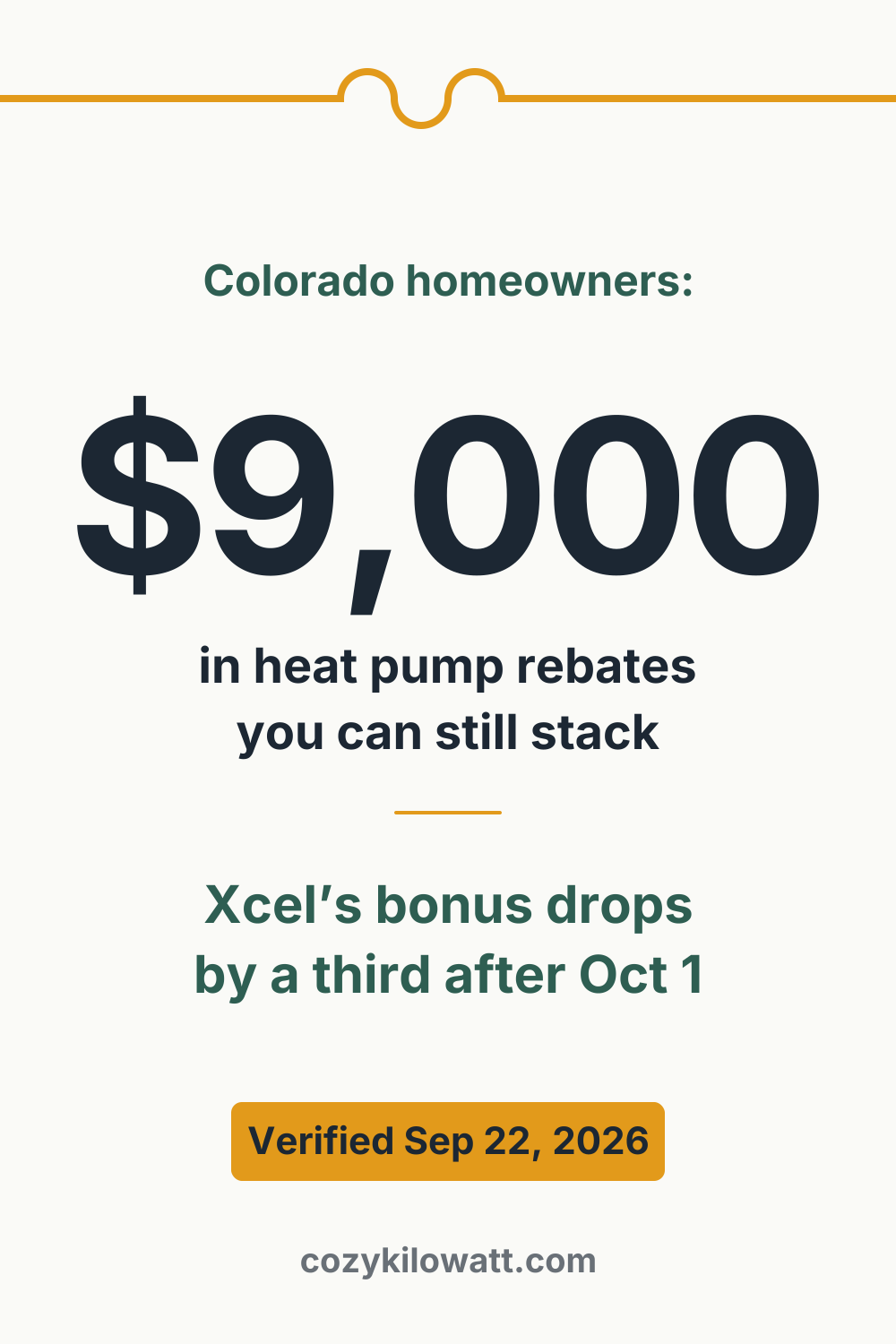
Colorado’s own heat pump tax credit is the sure money in 2026: $1,000 for an air-source heat pump, $2,000 for ground-source, $250 for a heat pump water heater, paid as a discount of at least a third on your installer’s invoice, at any income — verified on the Colorado Energy Office page on October 2, 2026. Xcel Energy cut its gas-heating bonus on October 1 and now sets one window: install and invoice by December 31, 2026, apply by September 30, 2027. Power Ahead Colorado still adds $1,500 on the Front Range. The federal HEAR rebate for houses is closed, with $0 left in both regions.
On this page: Does Colorado have rebates? · State tax credit · Xcel after October 1 · Xcel’s window · Power Ahead · Small multifamily HEAR · HER table · How to apply · Before you sign · FAQ
Every Colorado program at a glance
| Program | What it pays | Who qualifies | Status (Oct 2, 2026) |
|---|---|---|---|
| Colorado heat pump tax credit | Invoice discount of at least $333 (air-source, $1,000 credit) · $667 (ground/water/combined-source, $2,000) · $83 (heat pump water heater, $250) | Any income; registered contractor required; no paperwork for the customer | Paying now |
| Xcel Energy heat pump rebates | Amounts not printed by Xcel. Contractor-reported: about $1,500 per heating ton (cold-climate) and $600 per cooling ton since October 1; heat pump water heater reported at $2,250 | Xcel electric and/or gas customers in Colorado, any income, via participating (Trade Partner Network) contractors; Xcel’s heat pump page also describes a DIY mini-split path, its rebate pages require a contractor (read October 3) | Paying now — invoice by Dec 31, 2026; apply by Sept 30, 2027 |
| Power Ahead Colorado | $1,500 for a cold-climate heat pump in an existing building | Any income; participating Front Range counties (DRCOG-administered); opened June 29, 2026 | Paying now |
| HEAR — single-family | Paid up to $8,000 for a cold-climate heat pump, $14,000 max per household, while open | Was income-capped at 150% AMI; submitted proposals still in review until funds run out | Closed — $0 remaining in Region 1 and Region 2 (dashboard, Aug 3, 2026) |
| HEAR — small multifamily | Per-unit caps: cold-climate heat pump $8,000, heat pump $3,000, water heater $1,750, panel $4,000, wiring $2,500, insulation $1,600, stove $840; $14,000 total | Buildings under 50,000 sq ft; at least 50% of households at or below 150% AMI | $13.7M reserved; “not yet available” |
| HER — mobile homes & large multifamily | Mobile homes: 100% of cost up to $14,000–$16,000 below 80% AMI, 50% up to $2,000–$4,000 above. Buildings 50,000+ sq ft: $2,000–$8,000 per unit | Manufactured/mobile homes at any income; buildings with at least 50% of households meeting the income tier | Promised for 2026, no date |
| Federal 25C / 25D credits | Nothing for 2026 installs | — | Expired December 31, 2025 |
Does Colorado have heat pump rebates? What the official pages say today
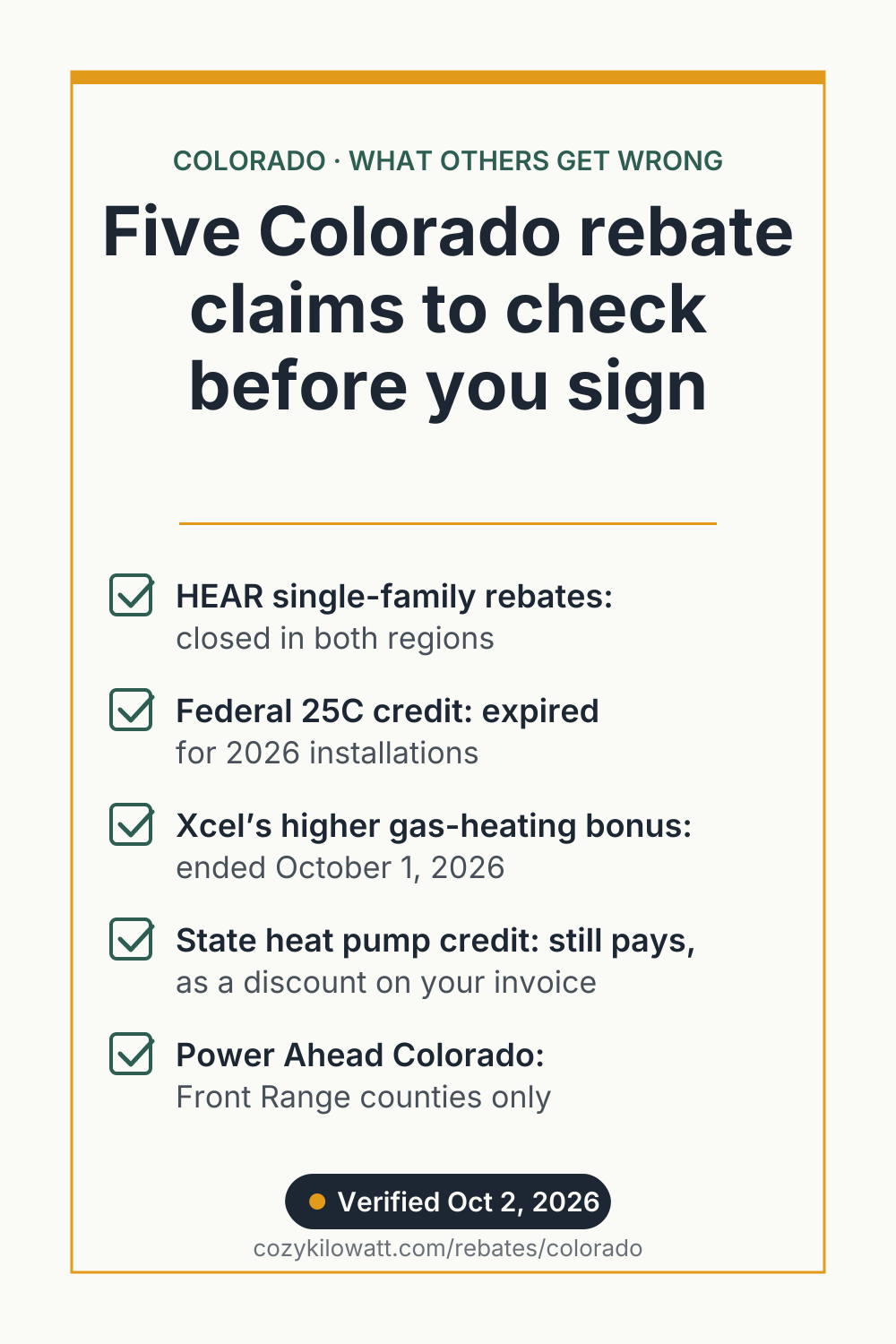
Yes — but the one most guides describe is closed. The Colorado Energy Office’s program page (updated August 2026) states that the HEAR single-family program is closed in Region 1, the fourteen Front Range counties from Larimer to El Paso, and in Region 2, the rest of the state; applications and project proposals submitted for Region 2 after August 1, 2026 “will not be reviewed and will be denied.” The HEAR dashboard, last updated August 3, 2026, shows $0 remaining in both regions out of $31.9 million for houses. Proposals already in the queue stay under review, and the office repeats that no rebate exists until a formal reservation notice arrives. What does pay today comes from the state and from your utility: the heat pump tax credit, Xcel’s rebates and, on the Front Range, Power Ahead Colorado. None of the three checks your income. A contractor quoting an “$8,000 federal rebate” for a Colorado house is quoting a closed program.
The Colorado heat pump tax credit, line by line (Form DR 1322)
This is the credit people search for, and it works unlike any federal one: you file nothing. For equipment installed on or after January 1, 2026, the state pays a registered contractor $1,000 for an air-source heat pump, $2,000 for a ground-source, water-source or combined-source system and $250 for a heat pump water heater. The contractor may keep up to two-thirds and must pass the rest to you as a line on the invoice labeled “State of Colorado Heat Pump Discount” — at minimum $333, $667 and $83. Many pass more, so ask when comparing quotes. The contractor then claims the credit on Department of Revenue Form DR 1322, the Heat Pump Tax Credit Schedule, with the year’s return. The expired 2024–2025 table was $1,500, $3,000 and $500 (minimum discounts $499.95, $999.90 and $166.65); there was no $1,250 year, whatever a search summary says. The amounts decrease again in tax year 2029.
How much is the Xcel heat pump rebate in Colorado after October 1?
Xcel’s own page, re-read on October 2, 2026, no longer mentions October 1, a bonus or any amount per ton; it says rebate amounts vary by qualifying equipment and cannot exceed installation costs. The figures reach homeowners through Xcel’s Trade Partner Network. Before the change, participating contractors reported $2,250 per heating ton for cold-climate heat pumps and $900 per cooling ton for standard ones; after October 1, with the gas-heating bonus reduced from three times to two times the standard rebate, the same contractors report about $1,500 and $600 per ton, and $2,250 for a heat pump water heater. We publish those numbers with that attribution and nothing stronger: get the rebate line in writing on your quote. What the page does state is who qualifies — residential electric and/or natural gas Xcel customers in Colorado — and that income-qualified customers may receive additional rebates and services covering up to the full cost of a heat pump, verified through the Home Energy Squad.
Xcel’s window: invoices by December 31, applications by September 30, 2027
One thing changed for the better on Xcel’s page: the deadlines are now official. It states that invoices and installations must be completed by December 31, 2026 and that rebate applications are accepted through September 30, 2027. We first published both dates on September 25 from one participating contractor, with a flag; the flag is gone and the entry on our deadlines page now cites Xcel directly. The path matters too. Xcel’s heat pump page describes a Trade Partner Network contractor who files the application and credits the rebate on the invoice or has Xcel send a check, or a mini-split you install yourself and apply for online; Xcel’s rebate information pages, read October 3, say equipment must be installed by a current participating contractor, and add a $600 bonus for insulation and air sealing completed before the heat pump. The October 15 date that contractors cited for September installs is not on Xcel’s page; we keep it flagged. Xcel’s rules on one page: Xcel Energy Colorado heat pump rebate.
Power Ahead Colorado: the newest $1,500
Opened June 29, 2026, Power Ahead Colorado is a roughly $40 million, four-year program administered by the Denver Regional Council of Governments. It pays a flat $1,500 for a certified cold-climate heat pump installed in an existing building, ducted or ductless, with no income requirement, in participating Front Range counties. Nothing about it changed on October 1: it is designed to stack with Xcel’s rebate and the state tax credit on the same project, and participating contractors handle the application. For a Denver-area 3-ton cold-climate install that means the state discount, the Xcel rebate at the contractor-reported post-October rate and Power Ahead can still land on one invoice. If your address sits in the DRCOG region, this is money most older guides do not mention at all — the program did not exist when they were written, and it is the newest line on this page.
HEAR for small multifamily buildings: $13.7 million, still not open
The closure applies to houses. The dashboard reserves $13.7 million of Colorado’s $45.6 million HEAR allocation for buildings smaller than 50,000 square feet and says plainly that rebates are “not yet available for multifamily buildings”; the program page promises them “in 2026” and gives no date, and the dashboard it points to has not been updated since August 3. When the phase opens, the per-unit caps are already published: $8,000 for a cold-climate heat pump, $3,000 for a standard heat pump, $1,750 for a heat pump water heater, $4,000 for an electric panel, $2,500 for wiring, $1,600 for insulation, air sealing and ventilation, $840 for an electric stove, $14,000 in total. Households below 80% of Area Median Income get 100% of qualified cost up to those caps; 80–150% get 50%. At least half the building’s households must meet the income tier, and every upgrade must be ENERGY STAR certified.
HER for mobile homes and large buildings: the full official table
The Home Efficiency Rebates (HER) program, also promised for 2026 without a date, pays for whole-home efficiency work and scales with modeled energy savings. For a manufactured or mobile home, a household below 80% AMI gets 100% of project cost up to $14,000 at 20–34% expected savings, or $16,000 at 35% and above; at 80% AMI and above the rebate is 50% of cost up to $2,000 or $4,000 — the only income-uncapped door in the federal program. For buildings of 50,000 square feet or more, with at least half of households below 80% AMI, the rebate is $4,000 per unit (or 80% of cost) at 20–34% savings and $8,000 per unit at 35% and above; at 80% AMI and above, $2,000 per unit up to $200,000 per building, or $4,000 per unit up to $400,000. Existing homes only, occupied at least half the year; new construction and vacation homes are out. Treat any launch date a contractor quotes as a guess.
How to apply, step by step
- Decide the equipment class first: only certified cold-climate systems earn Xcel’s higher per-ton rebate and Power Ahead’s $1,500 — ask for the AHRI number and the cold-climate listing.
- Pick a contractor who is BOTH on Xcel’s Trade Partner Network and on the state registered list for the heat pump tax credit — the two registries are separate.
- Ask for the quote to show each incentive as its own line: the Xcel rebate amount, the “State of Colorado Heat Pump Discount,” and Power Ahead where your county participates.
- Have the installation finished and invoiced by December 31, 2026; the contractor files the Xcel application (or you do, online, for a DIY mini-split) by September 30, 2027.
- Waiting on a submitted HEAR proposal? Watch the HEAR Dashboard and treat nothing as final until the reservation notice arrives.
- Questions on the state programs: Colorado Energy Office Help Center at 866-336-0016 or COenergyrebates@guidehouse.com.
Can you stack these programs?
Yes — the three live programs are built to combine on one project: Xcel’s rebate, the state tax credit discount and Power Ahead each draw on different money and all land on or before the invoice, so there is no rebate check to chase unless you choose Xcel’s check option. The practical limits: each program has its own contractor requirement (Xcel trade partner; state-registered for the credit), Power Ahead exists only in participating counties, and the Xcel rebate cannot exceed the installation cost. When the multifamily and mobile-home federal phases open, those rebates are expected to stack with the state credit as well — HEAR did while it was open, and Colorado’s page says a registered contractor may claim one state credit for each unit a heat pump serves in a multifamily building.
Before you sign a quote: what we’d verify
- Cold-climate certification, in writing. The per-ton difference between a cold-climate and a standard system is the 5°F rating — ask for the AHRI number and the cold-climate listing, not a verbal assurance.
- Both registries. Confirm the company on Xcel’s Trade Partner Network AND the state’s heat pump tax credit list; missing either forfeits that money.
- The Xcel amount, post-October. Xcel does not print it; a quote that still shows the pre-October bonus for an October install is wrong — ask for the current figure and for the application confirmation.
- The invoice line. The state discount must appear as “State of Colorado Heat Pump Discount” — and ask whether the contractor passes more than the minimum third.
- No 2026 single-family HEAR promises. A contractor quoting an “$8,000 federal rebate” for a Colorado house today is quoting a closed program with $0 on the dashboard — ask them to show you the open application.
- A real Manual J load calculation. Sizing decides both comfort and the per-ton rebate math. No load calculation, no signature.
Sources and method
Figures on this page come from primary sources, each read in full on October 2, 2026: the Colorado Energy Office Home Energy Rebate Program page (closure language, HEAR and HER tables, eligibility and documents), its HEAR dashboard (funding remaining, last updated August 3, 2026), the Colorado Energy Office heat pump tax credit page (2026 and expired 2024–2025 amounts, contractor rules, the 2029 step-down), Xcel Energy’s Colorado heat pumps page (eligibility, the December 31, 2026 and September 30, 2027 dates) and the IRS home energy credits page (25C/25D expiration). Xcel does not publish per-ton amounts; the figures shown are reported by participating contractors citing Xcel’s August 2026 trade-partner notice and are marked as such. Where we contradict third-party guides and search summaries — on HEAR being “available” for houses, or on a $1,250 credit year that never existed — we follow the official pages and log it. The date at the top is the proof.
Corrections involving Colorado. We log every error we find — ours and the market’s — with the official source: A contractor’s Xcel rebate guide says electric-only Xcel customers do not qualify. Xcel says electric and/or gas; Google’s AI Overview says Colorado’s heat pump credit was $1,250 in 2025. The official table says $1,500; We published Xcel Colorado’s program-year dates from one contractor. Xcel’s page now states them; A rebate calculator still says Colorado HEAR is open in Region 2; Colorado’s single-family HEAR was listed as live. It is closed statewide. See the full corrections log.
Frequently asked questions
- Does Colorado have heat pump rebates in 2026?
- Yes, but not the federal one for houses. The HEAR single-family program is closed in both regions and the official dashboard shows $0 remaining; new applications are denied. What pays now, at any income: the Colorado heat pump tax credit ($1,000 air-source, $2,000 ground-source, $250 water heater, taken as a discount on the installer’s invoice), Xcel Energy’s rebates through its trade partners, and Power Ahead Colorado’s $1,500 in participating Front Range counties. HEAR for small multifamily buildings and HER for mobile homes and large buildings are promised for 2026, with no date.
- How much is the Colorado heat pump tax credit in 2026?
- For equipment installed from January 1, 2026: $1,000 for an air-source heat pump, $2,000 for a ground-, water- or combined-source system and $250 for a heat pump water heater. The registered contractor claims the credit and must pass at least a third to you as a line on the invoice labeled “State of Colorado Heat Pump Discount” — at minimum $333, $667 and $83. The 2024–2025 amounts were $1,500, $3,000 and $500; the credit decreases again in tax year 2029.
- How much is the Xcel heat pump rebate in Colorado after October 1, 2026?
- Xcel does not print the amount on its page; it reaches you through participating contractors. Before October 1 those contractors reported $2,250 per heating ton for cold-climate systems and $900 per cooling ton for standard ones; after the October 1 reduction of the gas-heating bonus they report about $1,500 and $600 per ton. Treat both as figures to confirm in writing on your quote. What Xcel’s page does state: invoices and installations by December 31, 2026, applications accepted through September 30, 2027.
- Is there still a federal heat pump tax credit in Colorado?
- No. The federal 25C Energy Efficient Home Improvement Credit expired December 31, 2025 and cannot be claimed for equipment installed in 2026. Colorado’s own heat pump tax credit is separate and active; its amounts stepped down from $1,500 to $1,000 for air-source systems this year and decrease again in 2029.
- What if my income is over 150% of AMI?
- The programs that pay in 2026 do not check income: the Colorado heat pump tax credit, Xcel Energy rebates and Power Ahead Colorado are open at any income. HEAR was the only income-capped program, and it is closed to single-family applicants anyway. Households above 150% AMI in manufactured or mobile homes will still qualify for HER whole-home rebates (50% of cost, up to $2,000 or $4,000) when that program opens.
- Do renters, mobile homes and second homes qualify in Colorado?
- Renters can take part in the state rebate programs with written permission from the property owner, and rental units occupied by income-qualified tenants are eligible. Manufactured and mobile homes get their own HER track — up to $16,000 below 80% AMI — promised for 2026. Second homes and vacation homes are not eligible: you must live in the home at least half the year, and new construction is excluded.
- Is the small multifamily HEAR rebate open yet?
- No. The official dashboard (last updated August 3, 2026) reserves $13.7 million for buildings smaller than 50,000 square feet and states that rebates are not yet available for multifamily buildings. When it opens, the per-unit caps are $8,000 for a cold-climate heat pump, $3,000 for a standard heat pump, $1,750 for a heat pump water heater, $4,000 for an electric panel and $14,000 in total, with at least half of households at or below 150% AMI.
More state guides
Rebate rules are set state by state — see the full state-by-state registry, or jump to the other states we cover in depth: New York, Maryland, Wisconsin, Washington, Montana. For the federal side — what ended, what 2025 installs can still claim, and what replaced the credit — read heat pump tax credit 2026; for the news behind this page, see verified rebate news.