Washington heat pump & home energy rebates (2026)
Washington runs two programs called HEAR, and telling them apart is worth thousands of dollars. The state-funded HEAR (Climate Commitment Act money) is open and paying now through about 40 local administrators, for households at or below 150% of Area Median Income. The federal HARP/HOMES rebates — the “up to $8,000” most guides advertise — have not launched, have no date, and will not be retroactive. Meanwhile Seattle pays up to $6,000 for oil-to-heat-pump conversions, Chelan County PUD pays $1,600 to $3,300 in the Wenatchee area, and utility rebates from PSE, Seattle City Light, Tacoma Power and Snohomish PUD stack on top. The federal 25C tax credit expired December 31, 2025.
On this page: All programs · Two programs named HEAR · Federal HARP/HOMES · State HEAR · Seattle · Chelan County PUD (Wenatchee) · Douglas County PUD (East Wenatchee) · PSE, City Light, Tacoma, SnoPUD · How to apply · Stacking · Before you sign · FAQ
Every Washington program at a glance
| Program | What it pays | Who qualifies | Status |
|---|---|---|---|
| State HEAR (Climate Commitment Act) | Rebates on heat pumps, heat pump water heaters, induction cooking, heat pump dryers, panel and wiring upgrades; amounts vary by local administrator ($39.3M awarded to 40 administrators) | Households at or below 150% AMI including renters; small businesses and nonprofits with 50 or fewer employees; licensed adult family homes | Accepting applications (administrator list still growing) |
| Federal HARP / HOMES (IRA) | Will pay up to $8,000 for a heat pump and more — when it launches. Not retroactive | Households at or below 150% AMI, renters and multifamily included | Launching soon — step 5 of 7, no date |
| Seattle Clean Heat | $2,000 instant rebate for oil-to-heat-pump conversion, plus $4,000 bonus for moderate-income households (up to $6,000 total); no-cost conversions for income-eligible households via the Office of Housing | Seattle households heating with oil; base rebate at any income, bonus at 81–150% AMI; bonus for installations completed by May 30, 2027 per the official page | Accepting applications |
| Seattle City Light | $750 heat pump water heater rebate; smart thermostat rebates for electric heat through December 31, 2026 | Seattle City Light customers | Accepting applications |
| Chelan County PUD (Wenatchee, Leavenworth, Chelan) | $1,600 ductless (single-family), $2,000 (manufactured home), $1,000 per unit (multifamily 5+); $3,300 first-time ducted conversion; $600 upgrade to a variable-speed heat pump; income-qualified tiers of $2,100 / $2,700 / $4,300 from fall 2026 | Chelan PUD electric customers in existing homes heated with an electric forced-air furnace or permanently installed electric zonal heat (furnace added October 1, 2026); licensed HVAC contractor; 7.5 HSPF2 and 14.3 SEER2; application within 12 months | Accepting applications received April 1, 2026 – March 31, 2027 |
| Douglas County PUD (East Wenatchee, Bridgeport) | No heat pump or appliance rebate. Attic insulation only: $1,000 / $1,750 / $2,500 by attic size, plus $200 for PUD assistance-program households | Permanent residences with electric heat, existing attic at R-30 or less, finished at R-49 or more | Insulation rebate open for projects completed in 2026, funds limited; heat pumps: nothing |
| Puget Sound Energy | $1,500 base heat pump rebate, $2,400 with the Efficiency Boost, up to $4,000 for an income-qualified gas-to-heat-pump conversion | PSE customers; PSE Trade Ally or Recommended Energy Professional contractor required (since April 2026) | Accepting applications |
| Tacoma Power · Snohomish PUD | Roughly $1,000–$2,000 (Tacoma, flagged for confirmation); SnoPUD publishes $1,800 for a ducted conversion (7.5 HSPF2 / 13.8 SEER2) and $2,500 for an inverter-driven ducted heat pump (8.5 HSPF2), paid as an instant discount on the contractor’s bill | Customers of each utility; SnoPUD requires a PUD registered contractor and electric heat as the primary source | Accepting applications |
| Federal 25C / 25D credits | Nothing for 2026 installs | — | Expired December 31, 2025 |
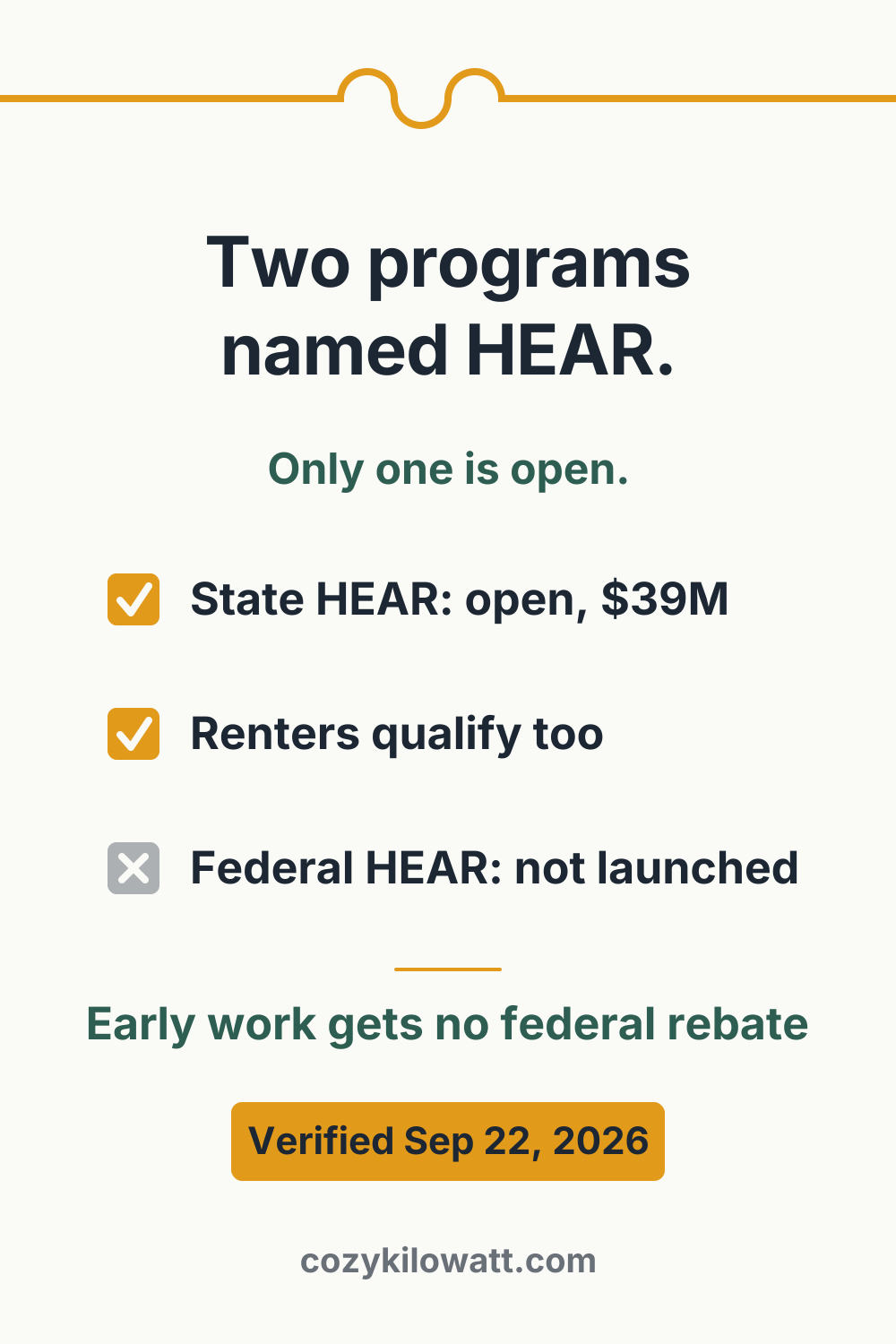
Two programs named HEAR. Only one is open.
This is the single fact that untangles Washington in 2026. The state Home Electrification and Appliance Rebates program is funded by Washington’s Climate Commitment Act — cap-and-invest dollars, not federal money — and it is running today: Commerce has awarded $39,323,876 to 40 local third-party administrators, from King County ($3.78M) and South Puget Sound Habitat for Humanity ($3.07M) to tribal governments and PUDs, who each run their own application process. The federal program — which Washington calls HARP, the one behind every “up to $8,000” headline — is a different animal entirely and has not opened. Guides, and some contractors, quote the federal amounts as if they were claimable today; on the official pages they are not. When someone promises you “the HEAR rebate,” the first question is always: which one?
The federal HARP/HOMES rebates: step 5 of 7, and not retroactive
Commerce’s own timeline places the federal rollout at step 5 of 7 — “program operation preparation” — with Guidehouse selected as rebate administrator in September 2025 and two steps still ahead: DOE launch approval, then statewide launch. The Department of Energy released revised program guidelines (notices 26-1 and 26-2) on June 1, 2026, and Commerce is evaluating how the changes affect the program. No launch date is published. The detail that should drive your decisions is Commerce’s own warning: rebates are not retroactive — no rebate can be issued for purchases or work done before you are approved. Buying a heat pump today on the assumption you will claim the federal $8,000 later is a plan the official page explicitly rules out. If your income qualifies and your project can wait, waiting has a price too: nobody knows what the revised guidelines will do to amounts. If your project cannot wait, build the budget from the programs below, which exist.
The state HEAR: how the open program actually works
Unlike a single statewide portal, Washington’s state HEAR flows through local administrators — cities, counties, PUDs, tribes, community organizations — each with its own rebate menu and application process. Eligibility is unusually broad: households at or below 150% of county AMI including renters, small businesses and nonprofits with 50 or fewer employees, and licensed adult family homes. Eligible equipment covers ducted and ductless heat pumps, ground-source systems, heat pump water heaters, heat pump clothes dryers and washer-dryer sets, electric panel and wiring upgrades — and, rare among rebate programs, residential induction cooking equipment. Everything must be ENERGY STAR or AHRI certified. Amounts vary by administrator, and not every administrator offers every category, so the working step is finding yours: Commerce posts each administrator’s contact as contracts are finalized and suggests checking back every few days — if your county is not listed yet, the contract may simply not be signed.
Seattle: up to $6,000 off an oil conversion — and a deadline that moved
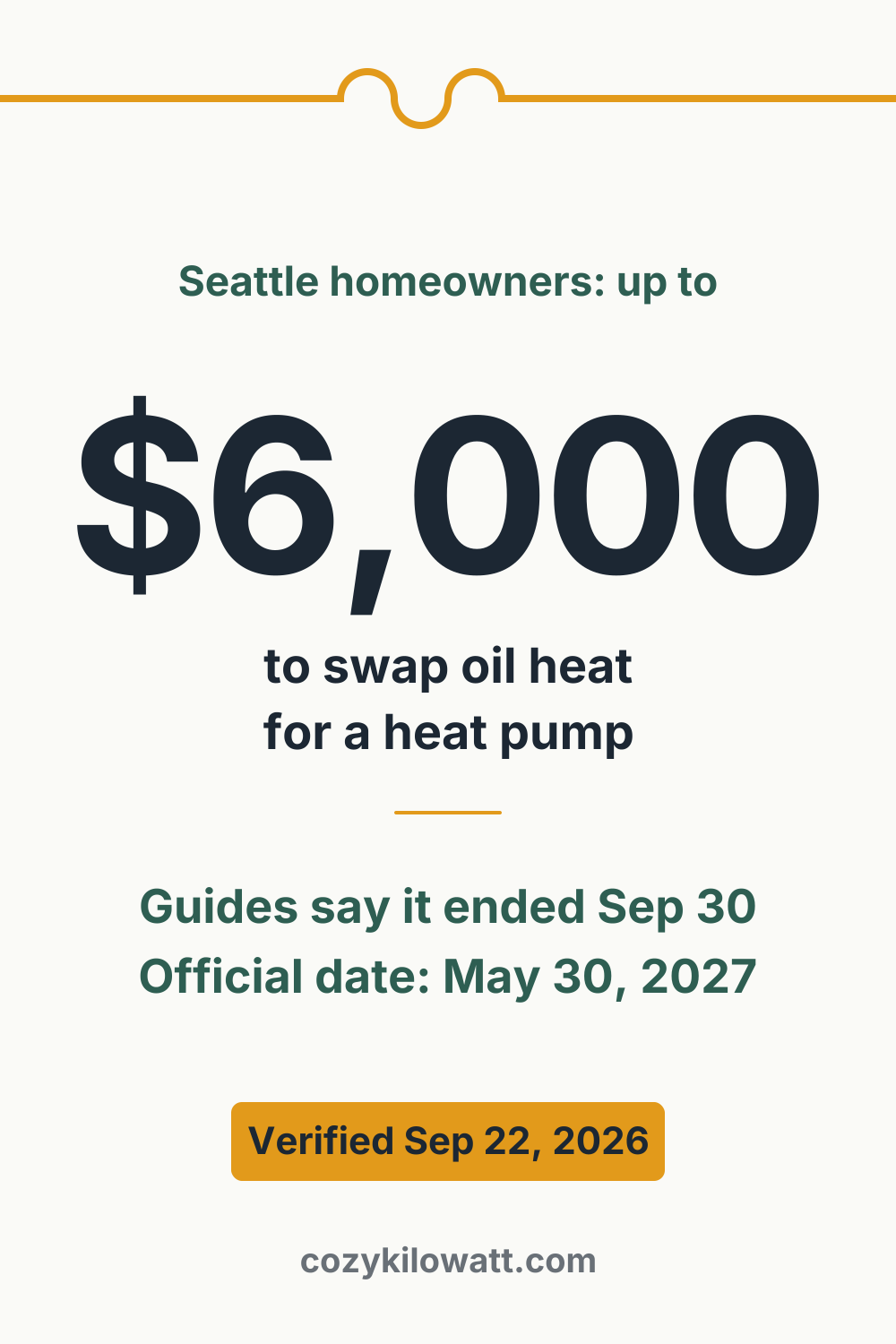
Seattle’s Clean Heat Program pays a $2,000 instant rebate, at any income, when a home heating with oil converts to a qualified heat pump through a participating contractor — applied straight on the invoice. Moderate-income households (81–150% of AMI) get a $4,000 bonus on top, for $6,000 total; the bonus is funded by the state HEAR program above. One correction worth money: several guides, including ones updated in August 2026, still cite a September 30, 2026 deadline for the bonus. The official Seattle program page now states bonus rebates are available for installations completed by May 30, 2027. We follow the official page — and because this date has already moved once, confirm it with the program before scheduling. Income-eligible households can do better than the rebate: a no-cost oil-to-heat-pump conversion through the Seattle Office of Housing, with free insulation via the HomeWise weatherization program. Roughly 8,000–10,000 Seattle homes still heat with oil; the city aims to convert them all by 2030.
Chelan County PUD: what Wenatchee, Leavenworth and Chelan homes get
For applications received April 1, 2026 through March 31, 2027, a first-time ductless (mini-split) conversion pays $1,600 in an existing single-family home, $2,000 in a manufactured home and $1,000 per unit in multifamily buildings of five or more units — in every case only when the home is currently heated with an electric forced-air furnace or electric zonal heat (furnaces were added on October 1, 2026). A first-time ducted conversion from a forced-air furnace pays $3,300, and upgrading an existing heat pump (or a gas furnace kept as backup) to a variable-speed inverter model pays $600, new construction included. The equipment must reach 7.5 HSPF2 and 14.3 SEER2, a licensed HVAC contractor must install it, and the rebate application is due within 12 months of installation. Chelan PUD also announces income-qualified rebates from fall 2026: $2,100 (single-family ductless), $2,700 (manufactured home) and $4,300 (ducted conversion). The full table and rules: Chelan County PUD heat pump rebates.
Chelan PUD: the four rules that disqualify a project
Four rules trip people up. A home that already has a heat pump, ducted or ductless, cannot claim a ductless rebate, and adding a head to an existing mini-split pays nothing. Homes that heated with a wood stove or plug-in space heaters do not qualify — eligibility is judged on the current heating type and last winter’s electric heating use, and vacation homes may be excluded. Removing a gas furnace to go all-electric is not rebated: the PUD states that federal law prohibits utilities from incentivizing fuel switching. And ducted conversions need contractor pre-authorization before installation; the contractor must also file the application, with a sizing sheet and a commissioning worksheet. Ductless jobs can be filed by the customer, online or by mail, with before-and-after photos, an itemized invoice and the AHRI certificate. Checks arrive six to eight weeks after a complete application. Official page: Chelan PUD heat pump rebates; questions to the Customer Energy Solutions team, (509) 661-8008.
Douglas County PUD: East Wenatchee is a different utility, with no heat pump rebate
The Columbia River is a rebate boundary. East Wenatchee, Bridgeport and the rest of Douglas County are served by Douglas County PUD, whose official conservation page (updated April 16, 2026) states that it does not offer residential rebates on appliances or energy-saving measures. Contractor pages promising Douglas “heat pump incentives” are wrong on this point — see our corrections log. What Douglas PUD does fund in 2026 is attic insulation: $1,000, $1,750 or $2,500 by attic size, plus $200 for households in a PUD assistance program, for permanent residences with electric heat whose attic sits at R-30 (about 10 inches) or less and is brought to R-49 or more, completed in 2026, funds limited (see what insulation pays in 2026). One caution: the same page still points to “tax credits under the Inflation Reduction Act”; those credits ended for equipment placed in service after December 31, 2025. Official page: Douglas PUD Energy Conservation; conservation team (509) 884-7191.
Utility rebates: PSE, City Light, Tacoma, SnoPUD
Puget Sound Energy runs the largest utility program outside Seattle. PSE’s own rebate pages, read October 4, 2026, pay $1,500 to replace electric resistance heating with a qualifying ducted or ductless heat pump, $2,400 with Efficiency Boost for income-qualified households, and $4,000 for income-qualified customers replacing PSE natural gas heating — with one hard rule: the installer must be a PSE Trade Ally or Recommended Energy Professional, or the rebate does not exist. The full rules, including the 30-day application window on the gas program, are on our Puget Sound Energy heat pump rebates page. Seattle City Light adds a $750 heat pump water heater rebate through December 31, 2026. Tacoma Power pays roughly $1,000–$2,000 on ducted heat pumps (confirm with Tacoma Power). Snohomish PUD publishes $1,800 for a ducted conversion and $2,500 for an inverter-driven one, taken off the bill by a PUD registered contractor — see our Snohomish County PUD page. For low-income households anywhere, the state Weatherization Program, LIHEAP and the Home Rehabilitation Grant Program remain open.
How to apply, step by step
- Check your household income against your county’s 150% AMI threshold in the state HEAR materials — this decides which doors are open.
- Income-qualified: find your local administrator on the Commerce list and follow their application process; if your county is missing, check back — contracts are still being finalized.
- Seattle + oil heat: get quotes from participating Clean Heat contractors; the $2,000 (and the bonus, if you qualify) lands as an invoice discount. Income-eligible households should ask the Office of Housing about the no-cost conversion first.
- PSE territory: confirm the contractor is a PSE Trade Ally or REP before signing — an out-of-network installer forfeits the rebate.
- Do not budget around the federal HARP $8,000: it has no launch date and cannot be claimed retroactively. Sign up for Commerce’s updates and revisit when step 7 arrives.
- Chelan PUD territory: check your current heating type against the PUD’s table; for a ducted conversion, your contractor requests pre-authorization before any work; file within 12 months. East Wenatchee (Douglas PUD): no heat pump rebate — apply for the attic insulation rebate instead if your attic is under R-30.
- Questions on state programs: HomeRebates@Commerce.wa.gov.
Can you stack these programs?
Yes, with per-program rules. Seattle’s own structure is a stack by design: the $2,000 city rebate plus the $4,000 state-HEAR-funded bonus on one invoice. State HEAR rebates and utility rebates generally combine — an income-qualified PSE or City Light customer can pair their utility’s rebate with the local administrator’s HEAR rebate — but each administrator sets its own rules, so confirm stacking with both programs before contracting. When the federal HARP eventually launches, its rebates are expected to sit on top of this landscape; until then, the stack is state + city + utility. The federal 25C credit is gone and adds nothing to any 2026 stack.
Before you sign a quote: what we’d verify
- Which HEAR the quote means. If a contractor cites “the HEAR rebate,” make them name the program: the state one (open, administrator-specific amounts) or the federal one (not launched). A quote built on the federal $8,000 is built on a program that does not exist yet.
- Your local administrator and their menu. Amounts and eligible equipment vary by administrator — get their current rebate sheet in writing, not a statewide generalization.
- The Seattle bonus deadline, from the program itself. The official page says May 30, 2027; older guides say September 30, 2026. Dates have moved once already — confirm before scheduling.
- Network membership, per utility. PSE’s rebate requires a Trade Ally/REP contractor; Seattle’s requires a participating Clean Heat contractor. Membership in one network is not membership in the other.
- No retroactivity gambles. Any plan that assumes claiming the federal rebate later for equipment bought now contradicts Commerce’s published rules.
- A real Manual J load calculation. Sizing decides comfort and running costs. No load calculation, no signature.
Sources and method
Figures on this page come from primary sources, each read in full on September 22, 2026: the Washington State Department of Commerce state HEAR page (award total, the 40 administrators, eligibility, equipment list), the Commerce IRA Home Energy Rebates page (the 7-step timeline, step 5 status, the June 1 DOE guideline revision, the non-retroactivity rule), the official Seattle Clean Heat Program page (rebate and bonus amounts, the May 30, 2027 bonus date) and Seattle City Light’s home energy pages ($750 heat pump water heater rebate, thermostat dates). On September 27, 2026 we re-read the Commerce IRA page (still step 5 of 7, Guidehouse named as statewide administrator), the Chelan County PUD heat pump rebate page and rebate program updates (every amount, the 2026–27 window, the income-qualified tiers, the exclusions), the Douglas County PUD energy conservation page (no appliance rebates; the attic insulation program) and Snohomish PUD’s heating rebates page ($1,800 / $2,500). PSE and Tacoma Power amounts are drawn from program trackers and participating-contractor documentation and are flagged in the text for direct confirmation with each utility. Where we contradict third-party guides — on the federal program being “live” and on Seattle’s bonus deadline — we follow the official pages and say so. This page is re-verified on a set schedule; the date at the top is the proof.
Corrections involving Washington. We log every error we find — ours and the market’s — with the official source: Douglas County PUD’s conservation page still points customers to the expired IRA tax credits; An East Wenatchee HVAC contractor says Douglas County PUD “offers its own heat pump incentives”. It offers none; Google’s AI Overview for Wenatchee ductless rebates gives the wrong efficiency minimums; Guides still give September 30, 2026 as the end of Seattle’s oil-conversion bonus; Washington was listed as live. Only the state program named HEAR is open. See the full corrections log.
Frequently asked questions
- Is the $8,000 federal heat pump rebate available in Washington?
- No. The federal HARP/HOMES rebates are at step 5 of 7 with no launch date, and Commerce states they will not be retroactive — work done before approval gets nothing.
- What is the difference between Washington’s state HEAR and the federal HEAR?
- Two programs share the name. The state HEAR (Climate Commitment Act money) is open now through ~40 local administrators. The federal one (HARP, IRA money, up to $8,000) has not launched. Most Washington rebate confusion is these two being mixed up.
- What heat pump money can Washington households get right now?
- State HEAR rebates through local administrators (income-qualified), Seattle’s $2,000–$6,000 Clean Heat rebates for oil conversions, PSE’s $1,500–$4,000, City Light’s $750 heat pump water heater rebate, and Tacoma/SnoPUD programs.
- What is the deadline for Seattle’s Clean Heat bonus?
- The official page says installations completed by May 30, 2027 — not the September 30, 2026 date older guides still cite. Confirm with the program; it has moved once already.
- What if my income is over 150% of AMI?
- Seattle’s $2,000 base rebate, PSE’s standard tiers ($1,500–$2,400) and the Tacoma/SnoPUD rebates have no income limit. The income-capped layers (state HEAR, the Seattle bonus) are closed to you.
- What is the Chelan County PUD ductless heat pump rebate in Wenatchee?
- $1,600 for a first-time ductless heat pump in a single-family home with an electric forced-air furnace or electric zonal heat, $2,000 in a manufactured home, $1,000 per unit in multifamily (5+ units); $3,300 for a first-time ducted conversion and $600 for a variable-speed upgrade. Applications received April 1, 2026 – March 31, 2027; 7.5 HSPF2 / 14.3 SEER2; licensed contractor; file within 12 months. Income-qualified tiers ($2,100 / $2,700 / $4,300) from fall 2026.
- Does Douglas County PUD (East Wenatchee) offer a heat pump rebate?
- No — Douglas PUD says it offers no residential appliance or heat pump rebates. Its only 2026 rebate is attic insulation ($1,000 / $1,750 / $2,500, plus $200 for assistance households), electric-heated permanent homes, R-30 or less to R-49 or more, completed in 2026.
- Do renters, small businesses and adult family homes qualify in Washington?
- Yes — the state HEAR covers renters, small businesses and nonprofits with 50 or fewer employees, and licensed adult family homes, all at or below 150% AMI, through their local administrator.
More state guides
Rebate rules are set state by state — see the full state-by-state registry, or jump to the other states we cover in depth: New York, Maryland, Wisconsin, Colorado. For the federal side — what ended, what 2025 installs can still claim, and what replaced the credit — read heat pump tax credit 2026.