Wisconsin heat pump & home energy rebates (2026)
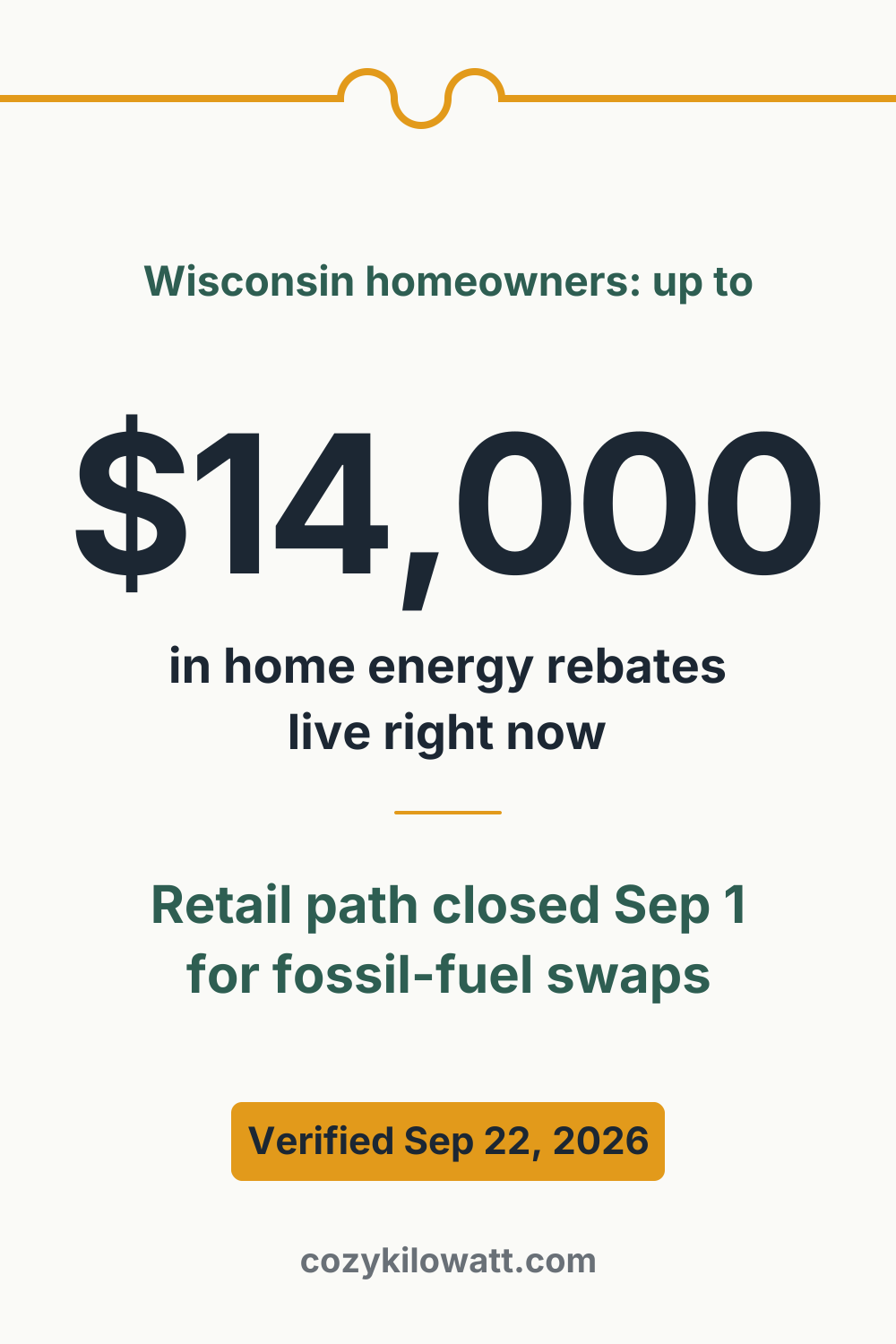
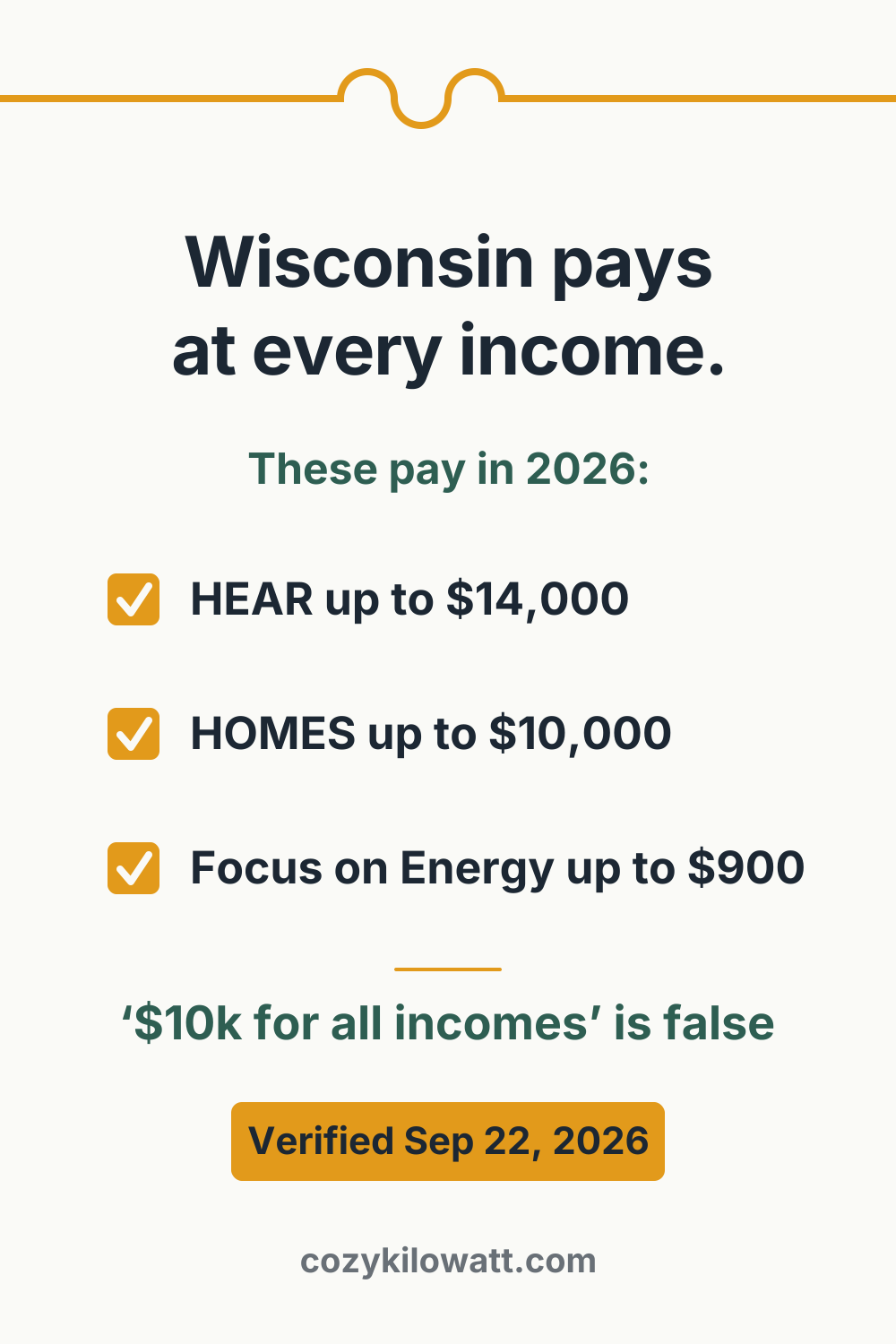
Wisconsin was the first state in the country to launch the federal Home Energy Rebates, and both programs are live in 2026: HEAR pays income-qualified households up to $8,000 for a heat pump and up to $14,000 per household in total, HOMES pays up to $10,000 for whole-home efficiency at any income, and Focus on Energy stacks $400–$900 instant heat pump discounts on top. The federal 25C tax credit expired December 31, 2025 — Wisconsin’s programs did not. One rule changed on September 1, 2026, and most guides haven’t caught up.
Every Wisconsin program at a glance
| Program | What it pays | Who qualifies | Status |
|---|---|---|---|
| HEAR — heat pump | Up to $8,000 for an ENERGY STAR electric heat pump; $14,000 max per household across all HEAR upgrades | Below 80% AMI: 100% of costs. 80–150% AMI: 50%. Above 150% AMI: not eligible | Accepting applications |
| HEAR — other upgrades | Heat pump water heater $1,750 · electrical panel $4,000 · wiring $2,500 · insulation, ventilation & air sealing $1,600 · heat pump clothes dryer $840 · electric stove/cooktop/range $840 | Same income rules; stove rebates only when replacing an existing electric appliance | Accepting applications |
| HOMES | 20–34% modeled savings: $5,000 / $2,000 / $1,500 by income tier. 35%+ savings: $10,000 / $4,000 / $3,000 | All incomes; project must cut energy use at least 20%; energy assessment required | Accepting applications |
| Focus on Energy — heat pump discounts | Instant discounts $400–$700 standard, $600–$900 income-qualified, in four SEER2/HSPF2 tiers ($100–$350 when replacing propane) | Customers of participating Wisconsin utilities, any income; through a Trade Ally contractor | Accepting applications |
| Focus on Energy — geothermal | $1,000 rebate (with natural gas service) or $750 (no gas service); smart thermostat $50 | Any income; applications within 60 days of install, no later than January 31, 2027 | Accepting applications |
| Federal 25C / 25D credits | Nothing for 2026 installs | — | Expired December 31, 2025 |
The federal credits ended. Wisconsin’s programs didn’t.
The 25C credit (30% of a heat pump install, capped at $2,000) and the 25D clean energy credit expired on December 31, 2025, and cannot be claimed for equipment installed in 2026. In Wisconsin, federal support now flows through the state’s $149 million Home Energy Rebates allocation, delivered by Focus on Energy under a Public Service Commission of Wisconsin decision. Wisconsin moved earlier than anyone: HOMES launched August 1, 2024 — first in the nation — the contractor-installed phase of HEAR followed on December 18, 2024, and store-purchased rebates opened September 30, 2025. One honest caveat from the PSC itself: Wisconsin has received updated federal guidance on the rebate programs, and while they remain fully operational during the review, program changes to comply with that guidance may follow. Funded projects are safe; the pool is finite.
HEAR: up to $14,000 for income-qualified households
HEAR is Wisconsin’s electrification program, and the income test decides everything. Households below 80% of Area Median Income get 100% of project costs covered; households between 80% and 150% of AMI get 50%; above 150% of AMI you are not eligible for this program at all. The cap is $14,000 per household across all HEAR upgrades combined, with per-category maximums: $8,000 for an ENERGY STAR electric heat pump, $1,750 for a heat pump water heater, $4,000 for an electrical panel, $2,500 for wiring, $1,600 for insulation, ventilation and air sealing, and $840 each for a heat pump clothes dryer or an electric stove — the stove rebate only when replacing an existing electric appliance. A household counts everyone living in the home, regardless of relation, and both primary and secondary residences qualify, as do rental properties and new construction for some measures.
What changed on September 1, 2026
Three weeks ago Wisconsin closed a door most guides still describe as open. As of September 1, 2026, the program no longer accepts retail post-purchase rebates or instant-discount coupon requests for equipment that replaces fossil-fuel appliances. Swapping a gas water heater for a heat pump unit bought at a store no longer earns the retail rebate — that project now has to run through an IRA Registered Contractor. The store path remains open for electric-to-electric swaps: a self-installed ENERGY STAR heat pump water heater replacing an electric unit, and qualifying kitchen and laundry appliances, still qualify at any participating store. Two transition details worth money: Lowe’s instant-discount coupons received before September 1 stay valid until their printed expiration date, and the program requires photos of your existing equipment before haul-away — skip the photos and the rebate is at risk.
HOMES: the real Wisconsin amounts, at every income
Several third-party guides quote HOMES in Wisconsin at “$4,000 to $8,000, doubled for low income” — those are the generic federal defaults, not Wisconsin’s actual table. The official matrix has six cells. For projects modeled to cut energy use 20–34%: $5,000 for households below 80% AMI (at 100% of project cost), $2,000 for 80–150% AMI, and $1,500 above 150% AMI (both at 50% of cost). For projects cutting 35% or more: $10,000, $4,000 and $3,000 on the same tiers. Unlike HEAR, HOMES is open at every income level. Every project needs a home energy assessment first, built on nine months of utility data; low-income households get up to $500 back toward the assessment cost. Multifamily buildings qualify per unit, with building caps up to $500,000, and can qualify wholesale for the low- or moderate-income level when at least half the tenants meet those thresholds.
Focus on Energy: the discounts that stack on top
Wisconsin’s utility-funded program is separate money, open at any income, and it stacks with both IRA programs. Air-source heat pumps earn instant discounts — taken straight off the contractor’s invoice, no forms — in four efficiency tiers: $400 at SEER2 15.2 / HSPF2 8.1, rising to $700 at SEER2 16.0 / HSPF2 10.0, with income-qualified households getting $600–$900 on the same tiers. One trap in the fine print: when the heat pump replaces propane heat, the discount drops to $100–$350 depending on tier. Beyond instant discounts, mail-in rebates cover certified geothermal heat pumps ($1,000 with natural gas service, $750 without) and ENERGY STAR smart thermostats ($50). Rebate applications must be filed within 60 days of installation and no later than January 31, 2027, and your utility must participate in Focus on Energy — check the participating-utilities list before you count the money.
How to apply, step by step
- Verify your household income against your county’s Area Median Income using the online income application — one approval covers both HEAR and HOMES.
- Find an IRA Registered Contractor; for HEAR heat pumps, confirm they participate specifically as a HEAR Installer and carry the equipment you want.
- Going the store route (electric-to-electric water heater, kitchen or laundry appliances): photograph your existing equipment before haul-away, keep proof of purchase, and submit the rebate request through the program portal.
- For HOMES, schedule the required home energy assessment; your contractor builds the project plan from the energy model and submits it for reservation, valid one year.
- After installation, the contractor (or you, for store purchases) submits for payment; approved rebates are processed in roughly 28 days.
- Questions at any step: Focus on Energy at 800-762-7077.
Can you stack these programs?
Partly — and the boundaries matter. You can participate in only one IRA program at a time, and one street address cannot collect both HOMES and HEAR rebates for the same upgrade type. But approval is shared: qualify for one and you are automatically approved for the other, so you can sequence different upgrades through different programs. The clean stack is IRA plus Focus on Energy: a HEAR heat pump project can also take the Focus on Energy instant discount, and a HOMES envelope project can take the utility program’s insulation rebates. Households at or below 80% AMI are automatically qualified for Focus on Energy’s income-based offers too — no second paperwork round. The Weatherization Assistance Program remains a further no-cost layer for households at or below 200% of the federal poverty level.
Before you sign a quote: what we’d verify
- Contractor status, precisely. “IRA Registered” is not enough for a heat pump — confirm the company participates as an IRA HEAR Installer in the official directory.
- Which discount tier your model hits. The Focus on Energy amount swings $300 between SEER2 15.2 and SEER2 16.0 / HSPF2 10.0 — ask for the exact tier in writing.
- What fuel you are replacing. Propane replacements cut the utility discount sharply, and since September 1, 2026, fossil-fuel replacements are barred from the retail HEAR path entirely.
- Photos before haul-away. Store-path rebates require photos of the old equipment; get them before the crew removes anything.
- A real Manual J load calculation. An oversized heat pump wastes the rebate and the savings. No load calculation, no signature.
- Your utility’s participation. Focus on Energy discounts exist only for customers of participating utilities — verify yours before pricing the stack.
Sources and method
Figures on this page come from primary sources, each read in full on September 22, 2026: the official Focus on Energy HEAR page (income tiers, per-measure caps, the September 1 retail change), the Focus on Energy HOMES page (the six-cell rebate matrix, assessment rules, multifamily caps), the Focus on Energy residential heating and cooling page (instant-discount tiers, geothermal rebates, the January 31, 2027 deadline), the Public Service Commission of Wisconsin federal funding page (program history, the federal guidance review), and the IRS home energy credits page (25C/25D expiration). Where we contradict third-party guides — on the HOMES amounts, on who administers the programs, and on the post–September 1 retail rules — we follow the official pages and say so. This page is re-verified on a set schedule; the date at the top is the proof.
Corrections involving Wisconsin. We log every error we find — ours and the market’s — with the official source: “HOMES pays $10,000 at every income” is false; A rebate calculator shows generic federal HOMES amounts for Wisconsin and names the wrong administrator; A Wisconsin guide misses the September 1, 2026 change and cites an expired deadline. See the full corrections log.
Frequently asked questions
- Is there still a federal heat pump tax credit in Wisconsin?
- No. The 25C credit expired December 31, 2025, and cannot be claimed for 2026 installs. Wisconsin’s programs remain open, and for income-qualified households they pay far more than the federal credit did.
- How much can a low-income household get?
- Below 80% AMI: 100% of HEAR project costs up to $14,000 per household — including $8,000 for a heat pump — or 100% of a HOMES whole-home project up to $10,000 at 35%+ modeled savings.
- What if my income is over 150% of AMI?
- HEAR is closed to you, but HOMES still pays 50% of a qualifying project up to $1,500 or $3,000 depending on modeled savings, and Focus on Energy discounts of $400–$700 apply at any income.
- Can I still buy a heat pump water heater at a store and get the rebate?
- Only when replacing an existing electric unit. Since September 1, 2026, retail rebates no longer apply to equipment replacing fossil-fuel appliances — those projects need an IRA Registered Contractor. Pre–September 1 Lowe’s coupons stay valid until their expiration date.
- Can I use HOMES and HEAR at the same time?
- One program at a time, and never both for the same upgrade type at one address — but approval for one automatically approves you for the other, and both stack with Focus on Energy rebates.
- Do renters and rental properties qualify?
- Yes. Renters qualify on their own household income with the owner’s consent, rental properties are eligible, and whole multifamily buildings qualify when at least 50% of tenants meet the income thresholds.
More state guides
Rebate rules are set state by state — see the full state-by-state registry, or jump to the other states we cover in depth: New York, Maryland, Colorado, Washington. For the federal side — what ended, what 2025 installs can still claim, and what replaced the credit — read heat pump tax credit 2026.