New York heat pump & home energy rebates (2026)
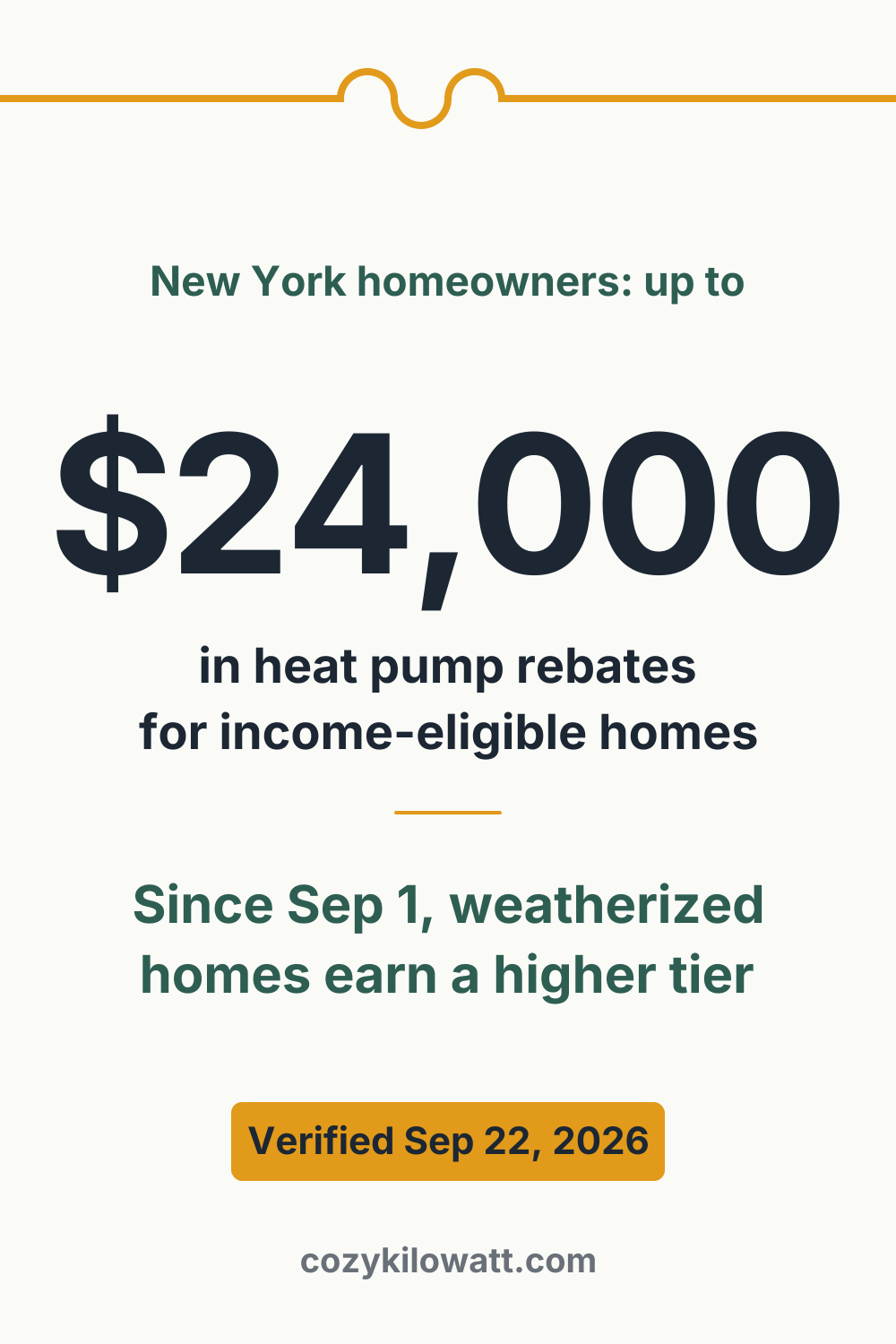
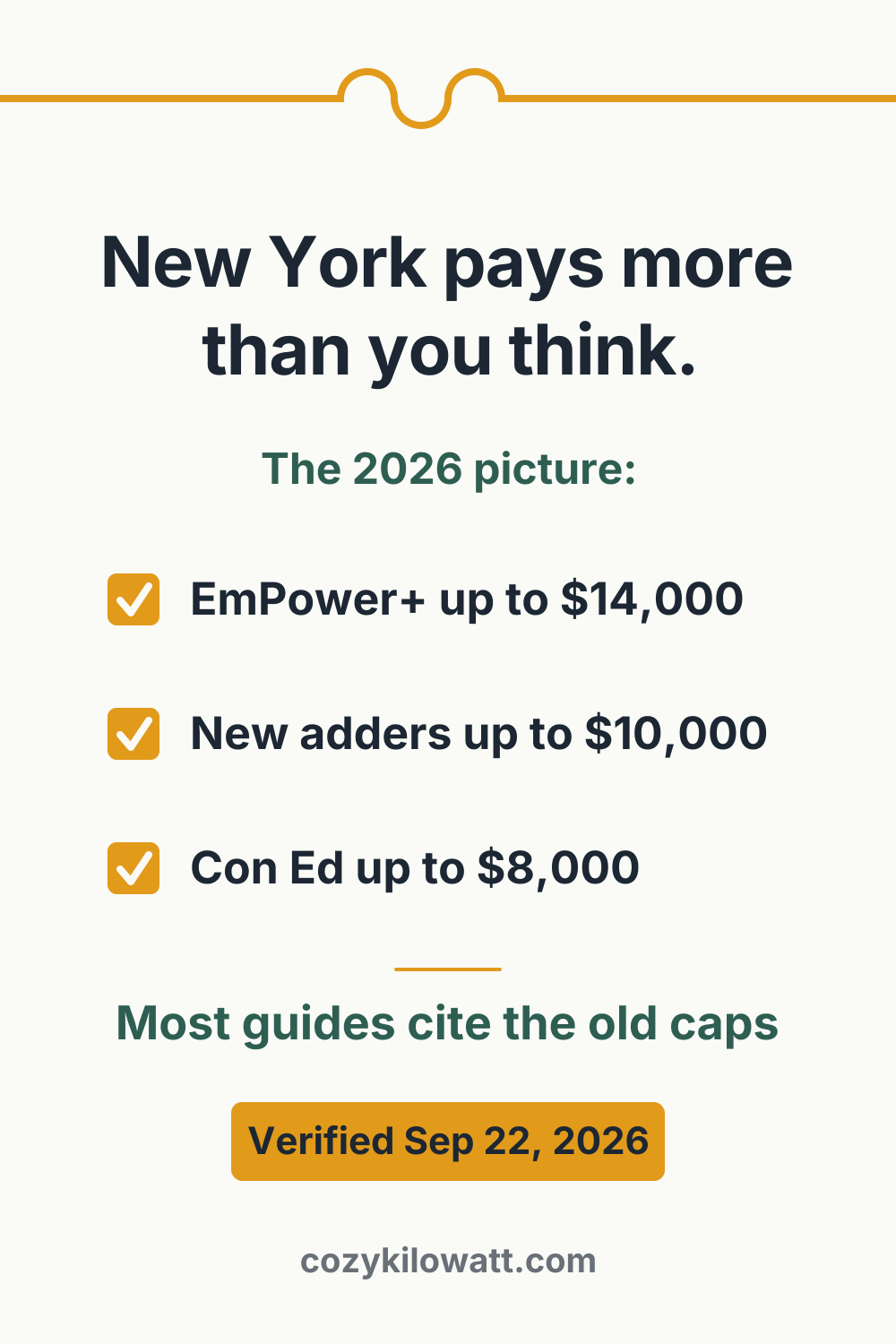
New York homeowners can claim heat pump money from three separate sources in 2026: NYS Clean Heat utility rebates (at Con Edison $7,000 standard or $10,000 weatherized for a single-family home, $8,000 and $11,000 in a Disadvantaged Community, no income limit), EmPower+ for income-qualified households (no-cost upgrades up to $14,000 downstate, $12,000 upstate), and the new Sustainable Futures Program, which adds up to $10,000 for a heat pump on top of EmPower+ caps. The federal 25C tax credit expired December 31, 2025 — these state programs did not.
Every New York program at a glance
| Program | What it pays | Who qualifies | Status |
|---|---|---|---|
| NYS Clean Heat — air source | Con Edison, read Oct 5, 2026: single-family $7,000 standard / $10,000 Weatherized Tier; Disadvantaged Community $8,000 / $11,000; apartments $3,500–$5,500. Full table on our Con Edison page. National Grid (Upstate), from the program manual of Sept. 1, 2026 read Oct 8: $4,000 standard / $8,000 weatherized, $7,000 / $12,000 with decommissioning, $6,000–$14,000 in a Disadvantaged Community — our National Grid page. Central Hudson, NYSEG and RG&E (manual Tables 4, 17–18, 22–23, read Oct 10): $4,000 standard / $8,000 weatherized, $7,000 / $12,000 with decommissioning; NYSEG and RG&E add $1,000 per cell in a Disadvantaged Community, Central Hudson instead caps at 85% everywhere — Central Hudson, NYSEG, RG&E. Orange & Rockland (Tables 27–28, read Oct 11): the same $4,000 / $8,000 and $7,000 / $12,000, plus $2,000 on every single-family cell in a Disadvantaged Community ($6,000–$14,000) — Orange & Rockland. Amounts vary by utility. | Any income; 1–4 unit homes; participating contractor required | Accepting applications |
| NYS Clean Heat — geothermal | Con Edison: $25,000 standard / $30,000 weatherized for a whole-building retrofit, $35,000 / $40,000 in a Disadvantaged Community (read Oct 5, 2026); National Grid $18,000 / $23,000, $23,000 / $28,000 in a Disadvantaged Community per the manual, while its page says “up to $25,000” (read Oct 8, 2026); Central Hudson $15,000 / $20,000; NYSEG and RG&E $15,000 / $20,000, $16,000 / $21,000 in a Disadvantaged Community (manual read Oct 10, 2026); Orange & Rockland $18,000 / $23,000, $20,000 / $25,000 in a Disadvantaged Community, while its page says $14,000 (manual read Oct 11, 2026) | Any income; 1–4 unit homes | Accepting applications |
| EmPower+ | No-cost upgrades up to $14,000 downstate / $12,000 upstate (low income); 50% of costs up to $7,000 / $6,000 (moderate income) | Income limits by county and household size; owners and renters of 1–4 family homes | Accepting applications |
| Sustainable Futures Program | Adders on top of EmPower+ caps: $10,000 air-source heat pump · $10,000 geothermal · $5,000 heat pump water heater · $5,000 panel box · $2,500 wiring | Through an approved EmPower+ project | Accepting applications |
| HEAR (federal, via EmPower+) | $1,600 for air sealing, insulation and ventilation (currently listed cap) | Income-eligible EmPower+ participants | Accepting applications |
| NY geothermal tax credit | 25% of system cost, up to $10,000, non-refundable state credit | NY taxpayers; systems placed in service on or after July 1, 2025 | Active for 2026 |
| Federal 25C / 25D credits | Nothing for 2026 installs | — | Expired December 31, 2025 |
The federal credits ended. New York’s programs didn’t.
The 25C credit (30% of a heat pump install, capped at $2,000) and the 25D clean energy credit both expired on December 31, 2025, and cannot be claimed for equipment installed in 2026. Federal support now flows through state-run doors — and New York’s are wide open. NYS Clean Heat is funded through 2030 under a Public Service Commission order, EmPower+ channels both state and federal dollars, and the new Sustainable Futures adders raise the ceiling further. For most New York households, the state stack in 2026 is worth more than the old federal credit ever was. One more 2026 change worth knowing: new buildings of seven stories or fewer must now be all-electric, which is tightening contractor availability — book early.
NYS Clean Heat: the utility rebate anyone can claim
NYS Clean Heat is a single statewide program run by NYSERDA with six investor-owned utilities — Con Edison, National Grid, NYSEG, RG&E, Central Hudson, and Orange & Rockland. There is no income test. The rebate arrives as an instant discount on your invoice, but only through a participating contractor — hire outside the network and the money simply does not exist. Since January 1, 2026, residential rebates apply only to homes of one to four units. Amounts differ by utility territory. In Con Edison territory, on the company’s own page read October 5, 2026, a single-family home that removes or disables its fossil-fuel system receives $7,000 at the standard rate or $10,000 at the Weatherized Tier, $8,000 and $11,000 in a Disadvantaged Community; keeping the old system with integrated controls pays $2,500. Con Edison’s amounts, tiers, geothermal, water heater, thermostat and Energy Exchange incentives are on our Con Edison page. The highest amounts require decommissioning the old furnace or boiler, not keeping it as backup.
In National Grid’s Upstate electric territory the utility’s own page shows its tier table only as an image, with “up to $12,000” and “up to $25,000” as the headline figures. The cells behind the image are in the NYS Clean Heat Statewide Program Manual, version 3 of September 1, 2026, read October 8: a single-family home earns $4,000 for a cold-climate air-source heat pump that keeps the old system, $7,000 with the old system decommissioned, $8,000 or $12,000 at the Weatherized Tier, and $6,000 to $14,000 in a Disadvantaged Community; geothermal pays $18,000 to $28,000. National Grid’s gas-only customers in Brooklyn, Queens, Staten Island and Long Island get their heat pump rebate from Con Edison or PSEG Long Island, not from National Grid, and National Grid’s own gas furnace and boiler rebates are closed. Every cell, the water heater and thermostat offers and the Priority Electrification bonus are on our National Grid page.
The three other Upstate utilities we have read in full, on October 10, 2026, share one standard rate since September 1: $4,000 for a single-family cold-climate heat pump that keeps the old system and $7,000 when it is decommissioned, $8,000 and $12,000 at the Weatherized Tier. Central Hudson, in the mid-Hudson Valley, prints those cells on its own page and is the one territory where incentives may reach 85% of project cost at any address; geothermal pays $15,000 or $20,000 — our Central Hudson page. NYSEG and RG&E, the two Avangrid utilities, add $1,000 to every cell in a Disadvantaged Community ($5,000 to $13,000) and pay $15,000 to $21,000 for geothermal, but their pages still advertise “up to $10,000” and “up to $18,000,” the cells of the manual that expired on August 31 — our NYSEG page and our RG&E page. All three pay $1,250 for a heat pump water heater without a contractor.
Orange & Rockland, read in full on October 11, 2026, completes the six: the same $4,000 and $7,000 standard cells and $8,000 and $12,000 weatherized, but a Disadvantaged Community adds $2,000 to every single-family cell rather than $1,000, and geothermal is the one Upstate cell the September manual raised — $18,000 standard, $23,000 weatherized, $20,000 or $25,000 on the map — while O&R’s own pages and the state’s acknowledgment form still print $5,000, $9,000 and $14,000, the March figures. Orange and Sullivan counties are shared with Central Hudson and NYSEG, so the name on the electric bill decides the table — our Orange & Rockland page. All six Clean Heat utilities are now read in full on their own pages and in the current manual.
New since September 1, 2026: the Weatherized Tier
On September 1, 2026, version 3 of the NYS Clean Heat Program Manual added a higher rate for homes that meet a weatherization standard, and lowered the standard rate beneath it at every Upstate utility. Three pathways qualify a home: built in 2011 or later; past participation in an approved program (NYSERDA’s Comfort Home packages A–C, NYSEG/RG&E’s insulation program, National Grid’s Total Home Comfort, Con Edison’s Weather Ready & Sealed, O&R’s Sealed Comfort Plan); or a documented heating load below 30, 25 or 20 Btu/h per conditioned square foot by home size. The tier changes the dollar cells — typically doubling the air-source amount and adding $5,000 to geothermal — not the cost cap: incentives stay limited to 70% of project cost, or 85% only in a Disadvantaged Community and in Central Hudson territory (our September 22 sentence giving the tier an 85% cap was wrong and is logged below). By March 1, 2028, weatherization becomes a prerequisite for all Clean Heat incentives. If your home is already tight, you just got a raise; if it is not, sealing and insulating first now earns money twice — once as its own rebate, once as the gate to the higher tier.
EmPower+: no-cost upgrades for income-qualified households
EmPower+ is NYSERDA’s program for low- and moderate-income households, open to owners and renters of one- to four-family homes. Low-income households receive no-cost improvements capped at $14,000 per project in downstate counties (New York City, Long Island and the lower Hudson Valley) and $12,000 upstate. Moderate-income households get 50% of costs covered, up to $7,000 downstate and $6,000 upstate. The money prioritizes core efficiency first — insulation, air sealing, health and safety — and once the envelope is done, contractors can recommend heat pump upgrades through the same project. Income limits vary by county and household size; check the official eligibility table before assuming you are over the line — roughly four in ten New York households qualify for some tier.
Sustainable Futures Program: the adders most guides miss
This is the part of New York’s 2026 stack that older articles get wrong. The state has made additional funding available through the Sustainable Futures Program, and it stacks on top of the EmPower+ project caps rather than counting against them. The maximums per improvement: $10,000 for an air-source heat pump, $10,000 for a ground-source (geothermal) heat pump, $5,000 for a heat pump water heater, $5,000 for a panel box upgrade, and $2,500 for electrical wiring. In practice this means a low-income downstate household can pair the $14,000 EmPower+ cap with a $10,000 heat pump adder — enough to make many full electrification projects free. Guides written before this structure appeared still quote the old federal HEAR caps; the official NYSERDA page now lists these amounts instead.
HEAR in New York right now
New York delivers the federal Home Electrification and Appliance Rebates through EmPower+, and the structure has shifted during 2026. As of our September 22 verification, the official EmPower+ page lists a HEAR cap of $1,600 for air sealing, insulation and ventilation, with the larger equipment amounts now carried by the Sustainable Futures Program above. Separately, the Appliance Upgrade Program pays up to $840 toward efficient appliances such as heat pump clothes dryers. One honest caveat: the federal IRA dollars behind HEAR are subject to federal funding decisions, and amounts have already been restructured once this year. Treat the HEAR line as the figure most worth re-confirming on the day you apply.
The 25% geothermal tax credit
New York keeps its own geothermal incentive alive even after the federal 25D credit expired: a non-refundable state income tax credit equal to 25% of qualified geothermal system costs, capped at $10,000 for systems placed in service on or after July 1, 2025. It stacks with the Clean Heat geothermal rebate and, for income-qualified households, with EmPower+ and the Sustainable Futures geothermal adder. Because it is a tax credit rather than a rebate, you claim it on your New York return via the Department of Taxation and Finance — keep the itemized invoice and proof of the in-service date.
How to apply, step by step
- Check your income tier against the county eligibility table (low, moderate, or neither).
- Any income: find a participating Clean Heat contractor in your utility territory and ask for the rebate as an invoice discount.
- Income-eligible: gather income documents (award letter for HEAP/SNAP/TANF/SSI, or pay stubs / tax returns) plus your electric and heating fuel bills.
- Create a profile on the MyEnergy Portal and submit the EmPower+ application.
- After approval, your assigned contractor performs a no-cost home energy assessment and submits an improvement plan; approved incentives are confirmed in writing before work starts.
- Stuck at any step: call 866-NYSERDA or contact your Regional Clean Energy Hub for free application help.
Can you stack these programs?
Yes — stacking is the design, not a loophole. The utility Clean Heat rebate, the EmPower+ project caps, the Sustainable Futures adders and the geothermal tax credit address different pots of money and combine on a single project. The contractor coordinates the stack: rebates land as invoice discounts, the tax credit comes later on your return. Two practical limits to remember: the air-source and geothermal tracks of Clean Heat are alternatives for primary heating, not additive, and every dollar of rebate requires the work to go through the approved channels — a participating contractor for Clean Heat, an approved project for EmPower+.
Before you sign a quote: what we’d verify
- Contractor status. Confirm the company appears in the official Clean Heat participating list for your utility — the rebate does not exist outside it.
- Your utility and DAC status. Amounts differ by territory, and Disadvantaged Community addresses earn more. Ask the contractor to show the exact figure for your address, not the statewide maximum.
- Decommissioning requirements. The top rebate amounts usually require removing the old fossil-fuel system. If you want it as backup, the number changes — get that in writing.
- Weatherized Tier eligibility. Since September 1, 2026, a qualifying envelope earns bonus money. Ask which pathway your home fits before pricing the project.
- A real Manual J load calculation. An oversized heat pump wastes the rebate and the savings. No load calculation, no signature.
Sources and method
Figures on this page come from primary sources, each checked on September 22, 2026: the official NYSERDA EmPower+ program page (project caps, Sustainable Futures amounts, HEAR cap, application steps), cleanheat.ny.gov and NYS Clean Heat Program Manual v2 (utility rebates, Weatherized Tier dates, 2028 weatherization requirement), the IRS home energy credits page (25C/25D expiration), and New York State tax guidance (geothermal credit); Con Edison’s air-source and geothermal pages were read in full on October 5, 2026; National Grid’s on October 8; Central Hudson’s, NYSEG’s and RG&E’s, and manual version 3, on October 10, 2026; Orange & Rockland’s on October 11, 2026. When a source conflicts with older third-party guides, we follow the official page and say so. This page is re-verified on a set schedule; the date at the top is the proof.
Corrections involving New York. We log every error we find — ours and the market’s — with the official source: A search engine’s AI answer for “orange & rockland heat pump rebate” gives the March 2026 cells and lists New Jersey’s geothermal terms as a New York rebate; The state’s Clean Heat Participation Acknowledgment Form for Orange & Rockland customers (2026, version 06) prints the incentive table of the manual that expired August 31, 2026; Orange & Rockland’s air-source, ductless and geothermal pages give $5,000, $9,000 and $14,000 for a single-family home. Those are the March 2026 manual’s cells; since September 1, 2026 the standard cells are $4,000, $7,000 and $18,000, with a Weatherized Tier and a $2,000 Disadvantaged Community adder above them; A search engine’s AI answer for “central hudson heat pump rebate” gives “$8,000 if removing / $5,000 if not,” “over $5,744+ per project,” geothermal “$8,000 to $18,000,” and says the rebate may combine with EmPower+. The current cells are $7,000 / $4,000 ($12,000 / $8,000 weatherized), geothermal $15,000 / $20,000, and the two programs cannot pay for the same heat pump; A search engine’s AI answer for “nyseg heat pump rebate” says the rebate is “$1,200 per 10,000 BTU” (air-source) and “$1,500 per 10,000 BTU” (geothermal), with a “$900–$1,250” water heater tier and a pre-approval form “before work starts.” NYS Clean Heat has paid flat per-home tiers since January 1, 2026, and Upstate applications are filed after installation; Central Hudson’s heat pump water heater rebate is $1,250 on its rebate page and in the September 2026 manual. The same page’s search description and Central Hudson’s Shop Local page still say $1,000; Central Hudson’s heat pump page lists “$8,000 if completing qualified weatherization work and removing” the old heating source under its “$4,000 if not removing” line. In the manual, $8,000 is the weatherized cell without decommissioning; weatherized plus removal is $12,000; A Central Hudson contractor sell sheet on the state’s Clean Heat Connect site lists $5,000, $8,000 and $18,000 for 2026. Since September 1, 2026 the standard cells are $4,000, $7,000 and $15,000, with weatherized cells of $8,000, $12,000 and $20,000; Rebate directories list the Central Hudson heat pump rebate at “up to $2,500” or “$500 to $3,500 based on efficiency rating,” and a utility-comparison site says Central Hudson offers no heat pump rebate. The 2026 rebate is $4,000 to $12,000 for air-source and $15,000 to $20,000 for geothermal; A rebate directory lists the NYSEG heat pump rebate at “up to $1,000” and gives RG&E no heat pump amount. NYSEG and RG&E pay $4,000 to $13,000 for a single-family heat pump under the September 2026 manual; NYSEG’s and RG&E’s Clean Heat pages say “up to $10,000” for an air-source heat pump and “up to $18,000” for geothermal. Those are cells of the manual that expired August 31, 2026; the current manual gives $7,000 standard, $12,000 weatherized, $13,000 in a Disadvantaged Community, and geothermal $15,000 to $21,000; Our New York page said the Weatherized Tier “unlocks … a higher project-cost cap of 85%” and launched “under Program Manual v2.” The 85% cap belongs to Disadvantaged Communities and to Central Hudson territory, not to the Weatherized Tier, and the tier was published in manual version 3; A search engine’s AI answer for “national grid heat pump rebate ny” says the thermostat pays “up to $75 upon enrollment” and geothermal rebates “average about $9,200.” National Grid’s pages say $50, and “an average of $7,000.”; National Grid’s ConnectedSolutions page pays $50 at sign-up for an electric thermostat. The same page’s own search description says $20; National Grid’s geothermal page says “Save up to $25,000.” The NYS Clean Heat Program Manual of September 1, 2026 lists National Grid’s geothermal incentives as $18,000, $23,000 or $28,000 — no $25,000; The AI answer for “con edison rebates” offers up to $4,000 for weatherization. The program is closed; Con Edison’s residential hub still advertises up to $4,000 for Weather Ready. The program page says it is closed; Our New York and Maryland pages mislabeled three states as “accepting applications”; New York guides quote the old HEAR caps and miss the Sustainable Futures adders; Guides describe NYS Clean Heat’s Weatherized Tier as a future change. It is live. See the full corrections log.
Frequently asked questions
- Is there still a federal heat pump tax credit in New York?
- No. The 25C credit expired December 31, 2025, and cannot be claimed for 2026 installs. New York’s state programs remain open and pay more than the federal credit did.
- How much can a low-income household get?
- Up to $14,000 in no-cost EmPower+ improvements downstate ($12,000 upstate), plus a $10,000 Sustainable Futures heat pump adder — many projects end up fully covered.
- Do I need to income-qualify for NYS Clean Heat?
- No. It is a utility rebate at any income, paid as an invoice discount through a participating contractor, in homes of one to four units.
- Can renters get New York rebates?
- Yes. EmPower+ accepts income-eligible renters in 1–4 family homes; the landlord signs off on the work.
- What is the Weatherized Tier?
- A bonus tier live since September 1, 2026: qualifying insulated homes get extra incentives and an 85% project-cost cap. Weatherization becomes mandatory for all Clean Heat incentives on March 1, 2028.
- Can I stack Clean Heat with EmPower+?
- Yes — the programs are built to combine, and your contractor coordinates the stack on one invoice.
More state guides
Rebate rules are set state by state — see the full state-by-state registry, or jump to the other states we cover in depth: Maryland, Wisconsin, Colorado, Washington. For the federal side — what ended, what 2025 installs can still claim, and what replaced the credit — read heat pump tax credit 2026.